Phytomem One review
Phytomem One reviews USA: a one-a-day chewable memory tablet with saffron, berberine, Ceylon cinnamon, Moro orange and kelp extracts — stimulant-free and sugar-free, but all ten ingredients share a 458 mg proprietary blend led by xylitol. What it gets right, what the microplastic story overstates, and the refund rules.

Our take: a gentle memory chew with a much bigger story than its label
If you are reading Phytomem One reviews, something has probably shaken your confidence. A name that will not come. Walking into a room and forgetting why. Losing your place on the page. Those moments are unsettling, especially when you have watched a parent or friend go through memory loss. Wanting to do something about it is completely reasonable.
Phytomem One is a one-a-day chewable memory supplement sold in the USA. It promises “clarity, memory, confidence” through a “dual-defense system” against two things: the “Plastic Stranglehold” (microplastics in the brain) and “Type 3 Diabetes” (the idea that the ageing brain becomes resistant to insulin).
Here is our honest verdict up front. Phytomem One has real strengths: it is stimulant-free, sugar-free, easy to take, and it contains saffron — the one ingredient here with human memory trials behind it. But all ten ingredients share a 458 mg proprietary blend, and the first ingredient listed, which means the largest by weight, is xylitol, a sweetener. Nothing in the formula has been shown to remove microplastics from the brain.
Phytomem One scores 2.6 out of 10 on our five published criteria, mostly for dose and transparency. This is a desk review: nobody on our team has taken it. We read the full label, the sales page and the refund and shipping policies, and checked each claim against published research.
What exactly are you buying?
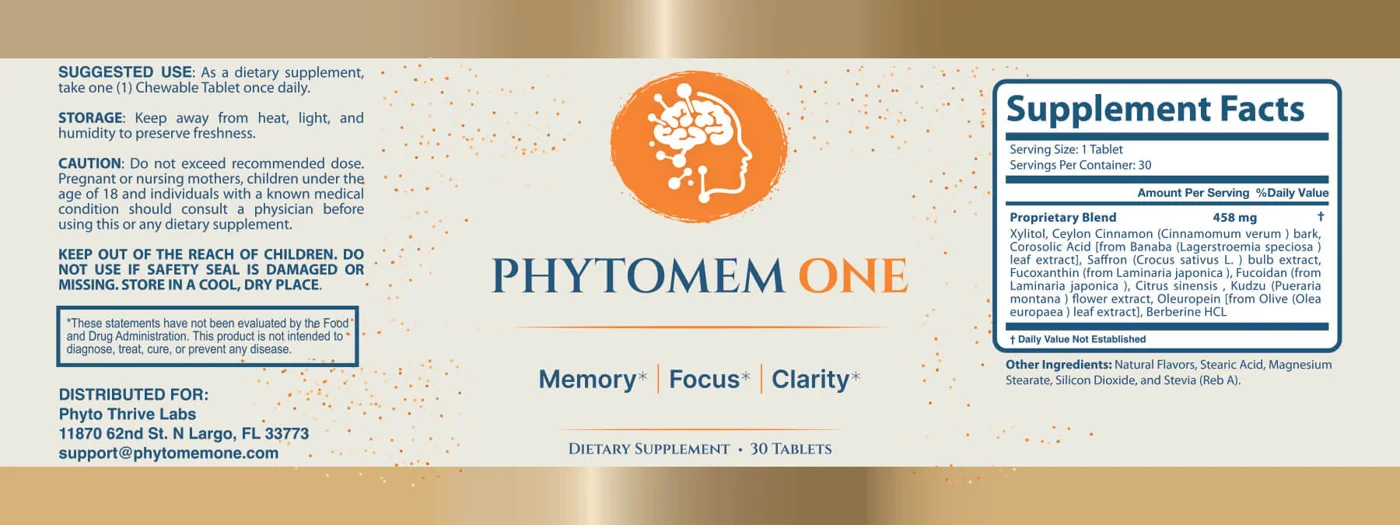
A bottle holds 30 chewable tablets, and you chew one a day, so a bottle lasts a month. The sales page FAQ says “one capsule daily with food”; the label says chewable tablet. Go by the label.
Per tablet, the Supplement Facts panel lists one item: a 458 mg proprietary blend of, in this order:
- Xylitol
- Ceylon cinnamon bark
- Corosolic acid (from banaba leaf extract)
- Saffron bulb extract
- Fucoxanthin (from kelp)
- Fucoidan (from kelp)
- Citrus sinensis — the Moro blood orange extract the sales page calls Morosil
- Kudzu flower extract
- Oleuropein (from olive leaf extract)
- Berberine HCl
US labels list blend ingredients from most to least by weight. So xylitol is the largest component, and berberine — sold as the formula’s “metabolic master switch” — is the smallest. No individual amounts are given.
Other ingredients are natural flavors, stearic acid, magnesium stearate, silicon dioxide and stevia. The distributor is Phyto Thrive Labs in Largo, Florida.
The advantages: where Phytomem One stands out
- Stimulant-free. No caffeine, no jittery “focus” buzz, nothing to keep you awake. That makes it easy to take every day.
- Sugar-free and chewable. Sweetened with xylitol and stevia. Good for anyone who struggles to swallow pills.
- It includes saffron. Saffron is the best-researched ingredient here for memory, with small randomized trials from Tehran University of Medical Sciences, as the sales page says.
- Ceylon cinnamon, not cassia. Ceylon (“true”) cinnamon is much lower in coumarin, a compound that can harm the liver in large amounts. Many budget products use cassia.
- A thoughtful theme. Blood-sugar health genuinely matters for the brain. Diabetes is a recognized risk factor for dementia, so a formula aimed at both is a sensible idea.
- No subscription. The page states a one-time purchase with no recurring charges, processed by ClickBank, and the charge shows discreetly on your statement.
What the evidence shows
The blend arithmetic. 458 mg across ten ingredients averages about 46 mg each — and because xylitol is the biggest, the nine actives share less than that.
Saffron is the strongest ingredient. In a 16-week randomized trial in people with mild to moderate Alzheimer’s disease, 30 mg of saffron a day did better than placebo on memory and thinking scores. The trials are small and mostly from one research group. 30 mg is a small amount, so saffron could plausibly be close to that dose here — but the label does not say.
Berberine genuinely lowers blood sugar in people with type 2 diabetes. But those trials used 500 to 1,500 mg a day, and they measured blood sugar, not memory. Here berberine is the smallest ingredient in a 458 mg blend.
Moro orange extract (Morosil) was studied at 400 mg a day for weight management over 12 weeks. That is almost the whole Phytomem One tablet on its own, so the amount here must be far lower.
Ceylon cinnamon, banaba (corosolic acid), kudzu and olive leaf have small studies for blood sugar or metabolism, usually at doses of hundreds of milligrams to grams. None has good human evidence for memory.
Fucoxanthin and fucoidan from kelp have interesting results in mice and lab dishes. We found no human trials showing they improve memory or repair brain damage.
Xylitol is a sweetener. The sales page calls it “clean fuel” for the brain; there is no evidence it helps memory.
The “Plastic Stranglehold” and “Type 3 Diabetes”: what is real
The sales story is built on two real scientific ideas, stretched well past what the science shows.
Microplastics in the brain are real. A 2025 study in Nature Medicine found microplastics in human brain tissue at autopsy, with higher amounts in people who had dementia. That is a striking and worrying finding. But it shows a link, not that microplastics cause memory loss — and no supplement, including this one, has been shown to remove microplastics from the brain.
“Type 3 diabetes” is a research hypothesis. Some scientists use the term for the insulin resistance seen in Alzheimer’s brains. It is not an official diagnosis. And while healthy blood sugar is good for the brain, there is no evidence that small amounts of berberine or cinnamon reverse it.
The page also cites a “Dr. Nakamura” we could not identify, and its own small print says names are changed and visuals may be “AI-assisted representations”, not real customers or medical professionals. Judge the product on its label, as we have here.
Safety
At these amounts, Phytomem One is unlikely to cause problems for most healthy adults, which is why it scores 6 out of 10 for safety. But some points matter:
- Diabetes medicines. Berberine, banaba, cinnamon and kudzu all lower blood sugar. Combined with metformin, insulin or other diabetes drugs, that could push sugar too low. Check with your doctor first.
- Drug interactions. Berberine affects how the liver processes many common medicines, including some statins, blood thinners and blood pressure drugs. Show the label to a pharmacist if you take any regular prescription.
- Pregnancy and breastfeeding. Berberine is not considered safe in pregnancy or for babies. Do not take it.
- Thyroid. Kelp-derived ingredients can carry iodine. Check with your doctor if you have a thyroid condition.
- Dogs. Xylitol is highly toxic to dogs, even in small amounts. Keep the bottle well out of reach.
New or worsening memory problems deserve a proper check-up. Several causes, such as low vitamin B12, thyroid problems, sleep apnea and medication side effects, are very treatable. The FDA does not approve supplements before sale, and no third-party test certificate is published.
Price and refund terms
Where to buy Phytomem One
Phytomem One is sold only through its official website. It is not available on Amazon, Walmart, eBay or in any store, so any listing there is not genuine stock from the brand and is not covered by the money-back guarantee. To order the real product, use the official Phytomem One website.
- 2 bottles: $79 a bottle, $158 total, plus $9.95 US shipping — about $2.80 a day
- 3 bottles: $69 a bottle, $207 total, free US shipping — about $2.30 a day
- 6 bottles: $49 a bottle, $294 total, free US shipping — about $1.63 a day
Every package includes three e-books. Mainland US delivery takes 5 to 8 business days.
The guarantee is advertised as a simple 60-day refund. The written refund policy adds conditions worth knowing:
- The 60 days run from delivery, which is fairer than from the order date.
- You must send back all the items you received to the Largo, Florida warehouse.
- You pay the return postage, and the refund is the purchase price minus shipping fees.
Keep the bottles, even empty ones, until you are sure. On a six-bottle order that is 180 days of product against a 60-day window, so decide early.
Best alternatives
We have not yet reviewed another memory supplement, so there are no comparison cards on this page. Options worth weighing:
- Saffron extract, 30 mg a day (not yet reviewed). The one ingredient here with memory trials, sold alone at the studied dose, usually for well under a dollar a day.
- A check-up and blood test (not a product). B12, thyroid and blood sugar are quick to test and very fixable.
- The habits with the best evidence: regular exercise, good sleep, managing blood pressure and blood sugar, treating hearing loss, and staying socially active all support memory as we age.
Who should skip it
Skip Phytomem One if you take diabetes medicine, blood thinners or several prescriptions without checking with your doctor; if you are pregnant or breastfeeding; or if you have a dog that could reach the bottle. Skip it if you are hoping a supplement will clear microplastics or reverse memory loss — nothing has been shown to do that.
Sources and shopping
Phytomem One suits an adult who wants a gentle, stimulant-free, sugar-free daily chew with saffron, who has had memory changes checked by a doctor, and who sees it as one small part of a brain-healthy routine. If that is you, the six-bottle pack is the best value at about $1.63 a day — but note the refund requires returning every bottle within 60 days of delivery.
Our commercial link is our Phytomem One link. We earn a commission if you buy through it, at no extra cost to you. It has no bearing on the 2.6 out of 10 above, which is what our five published criteria give a gentle formula whose amounts are hidden and whose biggest ingredient is a sweetener.
Ingredient analysis
Saffron bulb extract (Crocus sativus)
moderate evidenceThe strongest ingredient. Small randomized trials found 30 mg a day improved memory and thinking scores in mild to moderate Alzheimer’s disease over 16 to 22 weeks. The amount here is not disclosed.
Berberine HCl
weak evidenceLowers blood sugar in type 2 diabetes at 500 to 1,500 mg a day; not shown to improve memory. Listed last, so the smallest amount in the blend. Interacts with many medicines.
Moro orange extract (Citrus sinensis, Morosil)
weak evidenceStudied at 400 mg a day for weight management over 12 weeks, not memory. That dose would fill nearly the whole tablet.
Ceylon cinnamon bark
weak evidenceSmall studies for blood sugar at gram doses. Ceylon is the low-coumarin type, which is the safer choice.
Corosolic acid (banaba leaf), kudzu flower, oleuropein (olive leaf)
weak evidenceSmall human studies for blood sugar or metabolism at larger doses; no good human evidence for memory.
Fucoxanthin and fucoidan (kelp)
none evidencePromising results in mice and cell studies, but no human trials for memory or brain repair.
Xylitol
none evidenceA sugar alcohol sweetener, listed first so it is the largest component. No evidence it supports memory. Highly toxic to dogs.
Who it’s for. What to consider.
Who it may suit
US adults who want a gentle, stimulant-free, sugar-free daily memory chew with saffron, who have had any memory changes checked by a doctor, and who are not on diabetes medicines or other prescriptions that berberine could affect.
Who should avoid it
Anyone on diabetes medicine, blood thinners or several prescriptions without a doctor’s approval. Pregnant or breastfeeding women. People with thyroid conditions should check first. Dog owners should store it out of reach because of the xylitol.
What stands out
Stimulant-free: no caffeine or jittery “focus” ingredients
Sugar-free chewable tablet, sweetened with xylitol and stevia
Includes saffron, which has small randomized trials for memory at 30 mg a day
Uses Ceylon cinnamon, which is low in coumarin, rather than cassia
One-time payment with no subscription; 60-day refund counted from delivery
Worth considering
All ten ingredients share a 458 mg proprietary blend with no individual amounts
Xylitol, a sweetener, is listed first — the largest ingredient by weight
Berberine is the smallest ingredient, far below the 500 to 1,500 mg used in trials
No ingredient has been shown to remove microplastics from the brain
Refund requires returning all bottles at your cost, and shipping fees are not refunded
Sales page calls it a capsule while the label says chewable tablet
Score breakdown
Five criteria, each out of 10, averaged to the overall score. See how we score products.
Where to buy
Affiliate link: we may earn a commission at no extra cost to you.
Check the current priceYour questions, answered.
Does Phytomem One work?
We cannot say it does. Its best ingredient, saffron, has small trials for memory at 30 mg a day, but the label hides every individual amount in a 458 mg blend whose largest ingredient is xylitol, a sweetener. No ingredient has been shown to remove microplastics from the brain.
What do Phytomem One reviews in the USA say?
We found no independent, verifiable customer reviews yet. The sales page’s own small print says testimonial names are changed and some visuals are AI-assisted. Our review is based on the full label, the refund policy and published research.
What are the ingredients in Phytomem One?
A 458 mg proprietary blend of xylitol, Ceylon cinnamon, corosolic acid (banaba), saffron, fucoxanthin, fucoidan, Moro orange extract, kudzu flower, oleuropein (olive leaf) and berberine HCl, in that order, plus flavors, stearic acid, magnesium stearate, silicon dioxide and stevia.
Are there Phytomem One side effects?
Most healthy adults are unlikely to have problems at these amounts. But berberine, banaba, cinnamon and kudzu lower blood sugar and berberine interacts with many medicines, so check with your doctor if you take diabetes or other prescription drugs. Do not take it if pregnant or breastfeeding, and keep it away from dogs because of the xylitol.
How do you take Phytomem One?
Chew one tablet once a day, ideally with food. One bottle lasts 30 days.
Where can I buy Phytomem One? Is it on Amazon or Walmart?
Phytomem One is sold only through its official website. It is not available on Amazon, Walmart, eBay or in stores, and listings there are not covered by the money-back guarantee.
How much does Phytomem One cost?
Two bottles are $158 plus $9.95 shipping, three are $207 and six are $294, both with free US shipping. That is about $2.80, $2.30 or $1.63 a day.
What is the Phytomem One refund policy?
You have 60 days from delivery. Send back all the items you received to the Largo, Florida warehouse at your own cost; the refund is the purchase price minus shipping fees.
Can Phytomem One remove microplastics from the brain?
No supplement has been shown to do that. A 2025 study did find microplastics in human brain tissue, with more in people with dementia, but it showed a link rather than a cause, and no study has tested Phytomem One or its ingredients for removing them.
Community experiences
Reader submissions open once a page is published from the editorial database. This overview is maintained in code, so there is nothing to attach a submission to yet. If you have used this product, send it through the contact page and it will be considered when submissions open.
References
- Phytomem One official sales page, label image, refund policy and shipping policy — the source of every price, claim, ingredient, direction, warning and refund term quoted here, read on 20 November 2026. sharpandlean.com
- Akhondzadeh S, et al. Saffron in the treatment of patients with mild to moderate Alzheimer’s disease: a 16-week, randomized and placebo-controlled trial. J Clin Pharm Ther. 2010. pubmed.ncbi.nlm.nih.gov
- Akhondzadeh S, et al. A 22-week, multicenter, randomized, double-blind controlled trial of Crocus sativus in the treatment of mild-to-moderate Alzheimer’s disease. Psychopharmacology. 2010. pubmed.ncbi.nlm.nih.gov
- Nihart AJ, et al. Bioaccumulation of microplastics in decedent human brains. Nat Med. 2025. pubmed.ncbi.nlm.nih.gov
- The Effect of Berberine on Metabolic Profiles in Type 2 Diabetic Patients: A Systematic Review and Meta-Analysis of Randomized Controlled Trials. Oxid Med Cell Longev. 2021. pubmed.ncbi.nlm.nih.gov
- Cardile V, et al. Clinical evaluation of Moro (Citrus sinensis (L.) Osbeck) orange juice supplementation for the weight management. Nat Prod Res. 2015. pubmed.ncbi.nlm.nih.gov
- de la Monte SM. The Full Spectrum of Alzheimer’s Disease Is Rooted in Metabolic Derangements That Drive Type 3 Diabetes. Adv Exp Med Biol. 2019 — the research hypothesis behind the “Type 3 diabetes” term. pubmed.ncbi.nlm.nih.gov
- US Food and Drug Administration. Questions and Answers on Dietary Supplements. fda.gov
Page history
- All product figures read from the official sales page, label image and refund and shipping policies on this date. Product and label images are the brand’s own. No comparison cards: no other memory supplement has been reviewed yet.
- First published. Scored 2.6 out of 10 against the five published criteria. Dose scores 1 and transparency 2 because ten ingredients share an undisclosed 458 mg blend led by xylitol; safety scores 6 because the formula is stimulant-free but stacks several blood-sugar-lowering ingredients, including berberine with its drug interactions.