Learn
Learn.
Plain answers, with the evidence.
The questions people ask before they buy anything — how much protein, which vitamins, what GLP-1 actually does — answered from the research, with every figure linked to its source.
Work it out for yourself
Training and protein
Starting to exercise, and how much protein supports it.
 How to Get in Shape Fast for Women: Stronger in 8 WeeksBuild a routine that makes you stronger and fitter without crash dieting or spending every evening in the gym. This eight-week starting plan combines full-body strength, manageable cardio and food that supports recovery—with room for your actual life.Read the article
  How to Get in Shape Fast for Men: Your First 8 WeeksYou do not need a punishing six-day split to start looking and feeling fitter. Here is a practical eight-week framework for men: two strength sessions, manageable cardio, meals that support your goal, and a way to tell whether it is working.Read the article
 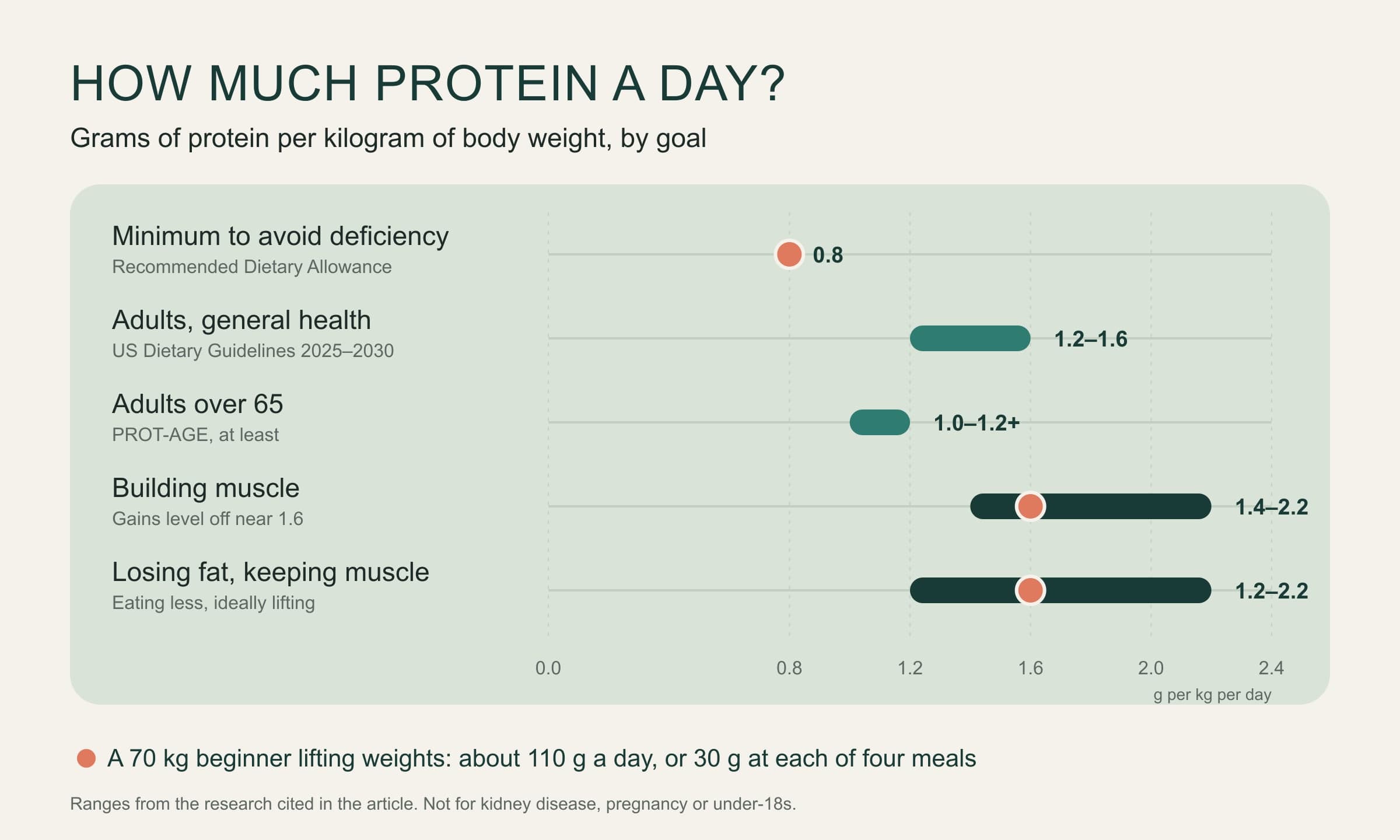 How much protein should a beginner eat in a day?About 1.2 to 1.6 g per kilogram of body weight a day, and about 1.6 g/kg once you start lifting — roughly 110 g for a 70 kg adult. Here is where those numbers come from, how to spread them across your meals, and a calculator that works out your own.Read the article
 Vitamins and everyday health
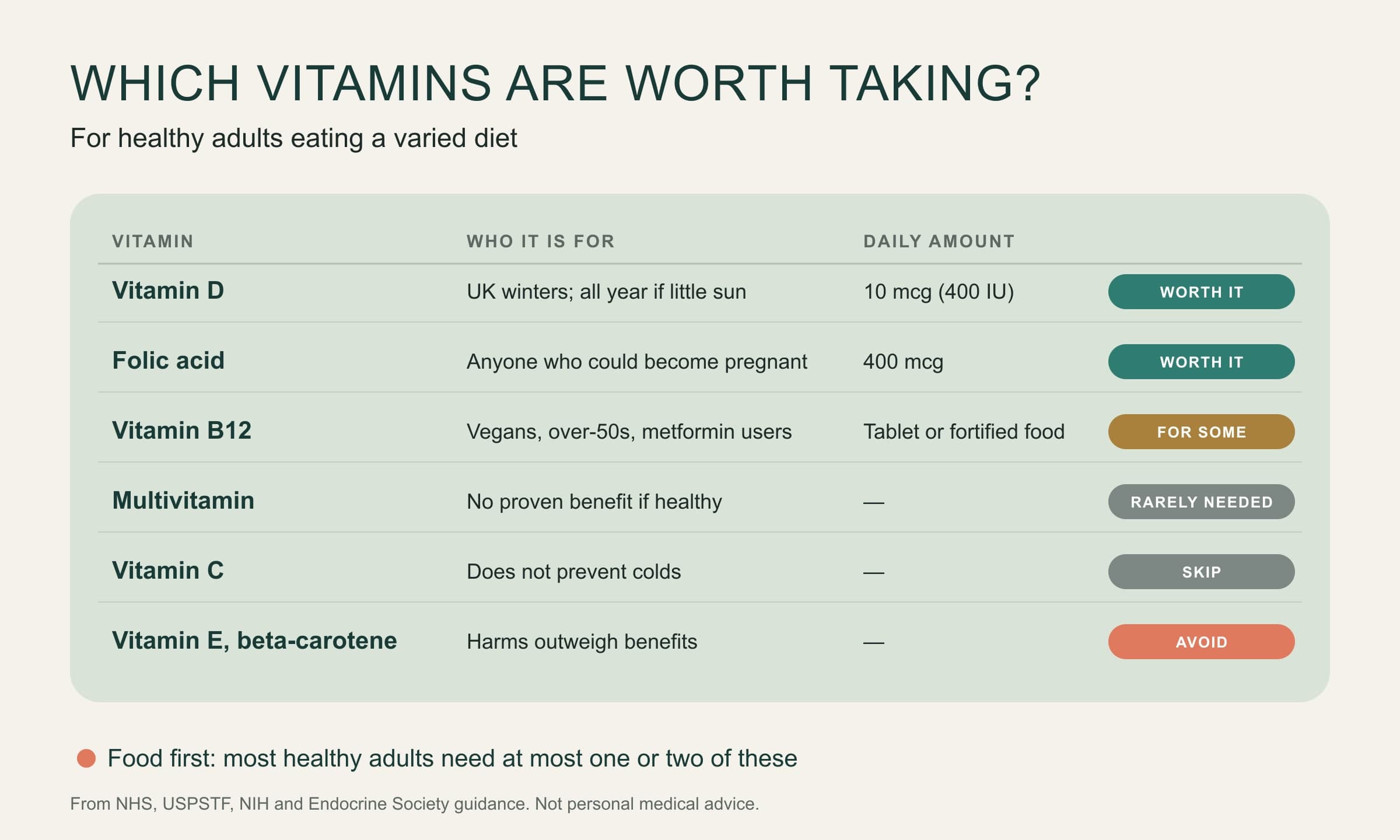
Which vitamins are worth taking, who needs them, and which to skip.
Weight loss and GLP-1
What GLP-1 drugs and supplements do, and the approaches with the best evidence.
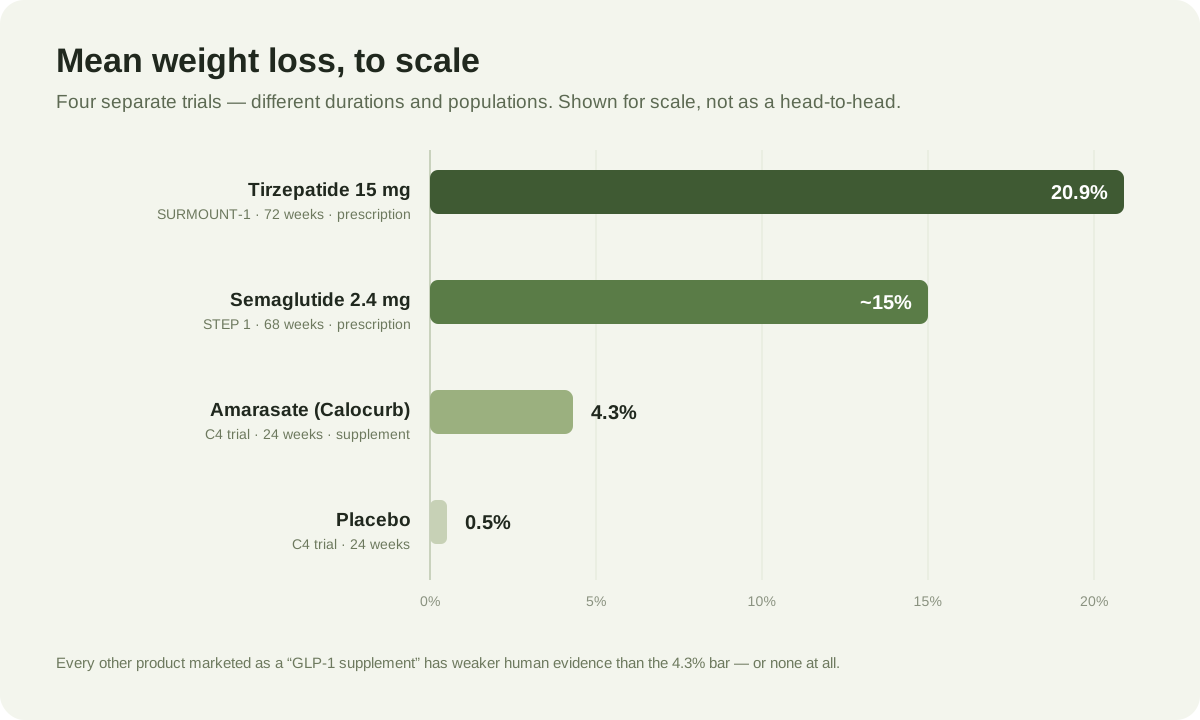 GLP-1, explained properlyA hormone your gut has always made, a drug class that reset what weight loss medicine can do, and a fast-growing aisle of supplements borrowing the name. This page separates the three, with every figure traced to its trial.Read the article Weight loss and GLP-1The best natural GLP-1 alternatives, ranked by what actually worksThere is no natural Ozempic. But some foods, eating habits and a few supplements measurably raise your own GLP-1 or make you eat less — and the best of them cost nothing. Eight options, ranked by what the trials show, with the numbers kept honest.Read the article
 Reference
Ingredient pages
One page per ingredient: what it does, what the research shows for each claim, how much to take and what to watch for.
Every claim is graded
- Grade A, strong evidence.Strong
- Grade B, moderate evidence.Moderate
- Grade C, limited evidence.Limited
- Grade D, weak evidence.Weak
- Grade F, not supported.Not supported
- Grade A, strong evidence.Vitamin DFat-soluble vitamin · 5 graded claimsUK advice (NHS): 10 mcg (400 IU) a day
- Grade A, strong evidence.Folic acidWater-soluble B vitamin · 4 graded claimsBefore and in early pregnancy: 400 mcg a day
- Grade A, strong evidence.Vitamin B12Water-soluble B vitamin · 6 graded claimsAdults need: 1.5 mcg (UK) · 2.4 mcg (US)
- Grade A, strong evidence.Whey protein blendProtein · 6 graded claimsProtein per scoop: 20–25 g typical
- Grade B, moderate evidence.Omega-3 (EPA and DHA)Fatty acid · 5 graded claimsBest supported: lowering triglycerides (A)
- Grade A, strong evidence.Psyllium huskSoluble fibre · 4 graded claimsStudied dose: 5–10 g a day
Skills for reading a label
Guides that teach something you can do yourself with a bottle in your hand.