Fruit and vegetable juice powder
DWeak evidenceAt a glance
- What it is
- Dehydrated juice or pulpNo standard composition and no legal definition. Two products carrying this ingredient line may share almost nothing.
- Amount in most formulas
- Not disclosedIt is listed without a quantity, which is permitted for a colour or flavour ingredient — and makes the nutritional implication impossible to check.
- Dose used in trials
- Six capsules a dayTaken as the supplement itself. That is orders of magnitude above a pinch used to tint a fibre drink.
- Best-supported effect
- Raises plasma carotenoidsReal, repeatable, and the strongest thing this ingredient class has going for it — at capsule doses.
- Replaces produce?
- No — and reviews say soIncluding a 2019 review with an author affiliated to the Juice Plus+ Science Institute, which states supplementation cannot replace fresh fruit and vegetables.
- Regulatory history
- FDA has acted on thisA 2019 warning letter cited a marketer claiming its capsules provided "over 10 servings of fruits and vegetables every day".
What is Fruit and vegetable juice powder?
Fruit and vegetable juice powder is exactly what the name says and nothing more specific: juice or pulp from some combination of produce, dried — by spray, drum or freeze drying — into a powder. There is no standard recipe, no defined composition and no legal definition of the term, so the ingredient line tells you the category and not the contents. What survives the drying varies with the method and the starting material. Carotenoids and some polyphenols hold up reasonably well; vitamin C degrades readily with heat and oxygen, which is why some powders have ascorbic acid added back and then list it separately. Fibre is largely removed when the starting point is juice rather than whole fruit. In practice these powders appear in two quite different roles, and conflating them is the source of most of the confusion on this page: as the entire product, in capsules taken by the handful, and as a small colouring and flavouring addition to something else.
How it works
There is no single mechanism, because this is a mixture rather than a compound. The plausible active constituents are the carotenoids, polyphenols, vitamins and minerals carried over from the source produce, and the proposed pathway is the familiar one offered for fruit and vegetable intake generally: antioxidant and anti-inflammatory activity, improved endothelial function, and reductions in markers such as homocysteine. The crucial limitation is that this reasoning is borrowed. The evidence that eating fruit and vegetables is good for people comes from studying people who eat fruit and vegetables — whole foods, with their fibre, water, structure and the displacement of other foods they cause. A dried juice extract shares some constituents with that and not others, so the benefit has to be demonstrated for the powder rather than inherited from the produce. Some of it has been. Most of it has not.
What the research actually shows
Evidence strength varies by what is being claimed, so each use is graded separately against the published criteria rather than averaged into one reassuring letter.
For raising plasma carotenoid and vitamin levels
BModerate evidenceThis is the strongest claim the ingredient class has, and it is a straightforwardly measurable one. Trials of encapsulated fruit, vegetable and berry juice concentrates consistently report increases in circulating carotenoids and several vitamins after supplementation. The reservation is not whether it happens but what it means: a higher plasma carotenoid reading is a biomarker of intake rather than a health outcome, and the studies establishing it have largely been short, small, and conducted in specific groups such as athletes and smokers. Raising a marker is a necessary step towards a benefit, not the benefit itself.
For cardiovascular risk markers
CLimited evidenceA 2019 systematic review in the Journal of Clinical Medicine gathered 13 articles covering eight concentrate products and reported movement in total cholesterol, LDL, homocysteine, systolic blood pressure, BMI and TNF-alpha, with the strongest signal for homocysteine. The authors were candid about the limits: small numbers of trials, small samples, most durations under two months, and heterogeneous designs, concluding that the effect on biomarkers and on primary cardiovascular disorders cannot be confirmed with certainty. Two further things belong in the reader’s hands. The evidence base is closely tied to industry — one author of that review lists an affiliation with the Juice Plus+ Science Institute while the paper declares no conflict of interest, and the individual trials are frequently funded or supplied by manufacturers. And the doses are those of the product taken on its own, not of a trace ingredient.
Sources: Lamprecht M, et al, Chapple ILC, et al
As a substitute for eating fruit and vegetables
FNot supportedNobody credible claims this, including the researchers most sympathetic to the ingredient: the 2019 review states that supplementation cannot replace the consumption of fresh fruit and vegetables. The FDA has treated the stronger versions of the claim as a compliance matter. Its 2019 warning letter to the marketer of a whole-food fruit and vegetable capsule range cited, among other violations, marketing asserting the products provided "over 10 servings of fruits and vegetables every day". Dietary guidance on produce rests on studies of people eating produce, and a dried extract lacks the fibre, volume, water and displacement effect that come with it.
Sources: US Food and Drug Administration, Lamprecht M, et al
At the amounts used for colour and flavour in a drink mix
FNot supportedThis is the version most readers of this site will actually encounter, and it is the weakest. Where a fibre powder or similar formula lists fruit and vegetable juice powder among its minor ingredients at an undisclosed amount, the quantity is there to tint and flavour the product. The trials showing biomarker effects used six capsules a day of concentrate taken as the supplement itself. A pinch in a 5 g scoop is smaller by orders of magnitude, and no evidence supports a nutritional contribution at that scale. The ingredient is doing an honest job; the packaging is the part that overstates it.
Sources: Chapple ILC, et al
Effective dosage
There is no established effective dose, because the ingredient is not standardised to anything. The most-studied form is encapsulated concentrate taken as the product in its own right — the periodontal trial in the Journal of Clinical Periodontology used six capsules daily, split morning and evening, over nine months, and that is broadly typical of the literature. Nothing comparable exists for powders used as a minor component of another formula, and no conversion between the two is meaningful. Where a product does quantify the powder, compare it against the gram-level daily amounts used in trials rather than against a serving of fruit, because no defensible equivalence to produce exists.
Where products diverge from the research. This is one of the widest gaps on the site, and it runs in both directions at once. The studied form is grams per day of concentrate taken as the whole product; the commercial form most people meet is an unquantified pinch used as a colourant. Meanwhile the implied benefit is the largest available — that you are somehow getting your produce in. When an amount is not disclosed you cannot close that gap yourself, and the absence of a figure should be read as what it is: the ingredient is present for appearance and taste, because an ingredient present for nutrition would have a number next to it.
Safety, side effects and interactions
At the amounts used in ordinary supplements this ingredient raises no particular safety concern; it is dried food. Three practical points are worth keeping. First, people with fruit or vegetable allergies need the source list, and a blanket ingredient line such as "fruit and vegetable juice powder" may not provide it — check the full declaration and the allergen statement rather than assuming. Second, concentrated fruit powders can carry meaningful amounts of sugar and of potassium or oxalate depending on what went into them, which matters for anyone managing diabetes, kidney disease or a history of oxalate stones. Third, and most relevant in practice, the risk is not toxicological but substitutional: treating a powder as a stand-in for produce means missing the fibre, volume and satiety that make fruit and vegetables useful in the first place. If you are eating well, this ingredient adds very little. If you are not, it does not fix it.
None of this is medical advice. See the medical disclaimer for what that means before you act on anything here.
Products we have covered containing Fruit and vegetable juice powder
Every label overview on this site whose Supplement Facts panel lists Fruit and vegetable juice powder, with the amount each one discloses.
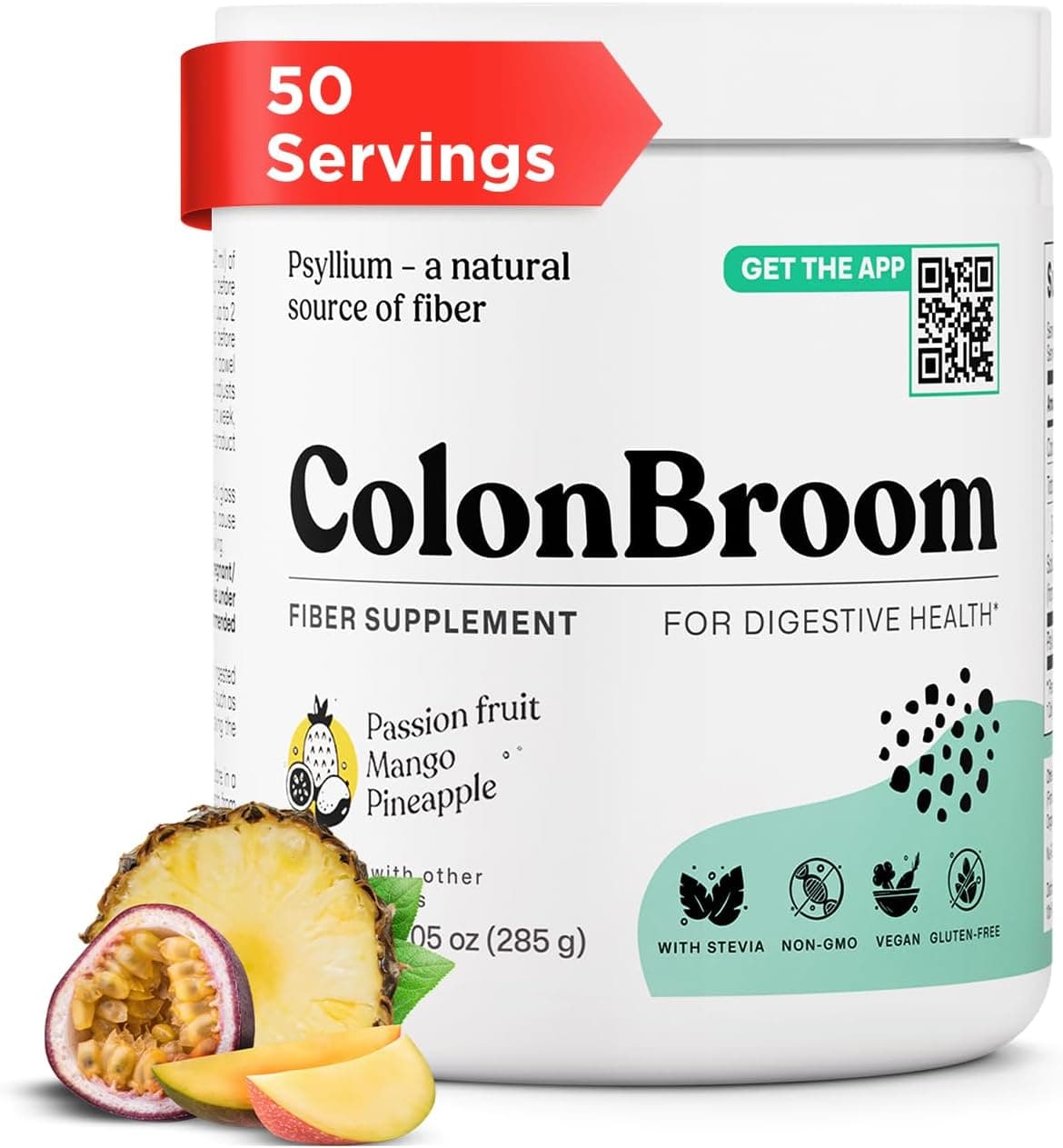
ColonBroom Psyllium Fiber Powder
ColonBroom puts a familiar fibre ingredient into a flavoured daily drink. We look at what psyllium can do, what a serving costs, and the label details to check before you buy.
Common questions
Does fruit and vegetable powder count as a serving of vegetables?
No. There is no defensible equivalence between a dried extract and a serving of produce, and the FDA has issued a warning letter over marketing that claimed capsules delivered more than ten servings of fruits and vegetables a day. Even the systematic review most favourable to concentrates states that supplementation cannot replace fresh fruit and vegetables.
Is there any real evidence for these powders?
Some, and it is worth being precise about it. Trials of encapsulated concentrates taken as the product itself do raise plasma carotenoid and vitamin levels reliably, and a 2019 review found modest movement in cardiovascular markers such as homocysteine. Those studies were small, short and often manufacturer-funded, and the authors concluded the effect on primary cardiovascular disorders cannot be confirmed with certainty.
Why is fruit and vegetable juice powder in my fibre supplement?
For colour and flavour, in almost every case. It is typically listed with no amount, which is permitted for a flavouring or colouring ingredient and is the clearest signal available of what it is doing. A component included for nutrition would carry a quantity.
Do these powders still contain fibre and vitamin C?
Often much less than the source produce. Fibre is largely lost when the starting material is juice rather than whole fruit, and vitamin C degrades with heat and oxygen during drying — some manufacturers add ascorbic acid back, which then appears separately on the panel. There is no standard process, so retention varies between products.
How much of the research is funded by the manufacturers?
A substantial share. The periodontal trial cited on this page was funded in part by the manufacturer of the product tested, and the 2019 systematic review includes an author affiliated with that manufacturer’s science institute while declaring no conflict of interest. That does not make the findings wrong, but it is context a reader is entitled to have before weighing them.
Should I take a greens or fruit-and-veg powder instead of eating vegetables?
No, and that framing is where the harm sits. The guidance to eat produce comes from studying people who eat produce, with the fibre, water and fullness that involves. A powder can raise some blood markers. It cannot do the displacement work that makes vegetables useful, and treating it as permission to skip them is a worse outcome than not taking it at all.
References
- Lamprecht M, et al. Fruit and Vegetable Concentrate Supplementation and Cardiovascular Health: A Systematic Review from a Public Health Perspective. Journal of Clinical Medicine. 2019;8(11):1914 — 13 articles across eight concentrate products; source of the biomarker findings, the stated limitations, and the conclusion that supplementation cannot replace fresh produce.
- Chapple ILC, et al. Adjunctive daily supplementation with encapsulated fruit, vegetable and berry juice powder concentrates and clinical periodontal outcomes: a double-blind RCT. Journal of Clinical Periodontology. 2012;39(1):62–72 — the six-capsules-daily dose cited on this page; funded in part by the manufacturer of the product tested.
- US Food and Drug Administration. Warning Letter to Evig LLC dba Balance of Nature, 20 August 2019 — cites marketing claiming the products provide "over 10 servings of fruits and vegetables every day", alongside unapproved drug claims and nutrition labelling violations.
Page history
- First published with per-claim evidence grades. Biomarker and cardiovascular findings from the 2019 Journal of Clinical Medicine systematic review; the studied dose and funding disclosure from the 2012 Journal of Clinical Periodontology trial; the servings claim from the FDA warning letter of 20 August 2019.
Related ingredients
Compiled by SNL Team