GLP-1, explained properly
A hormone your gut has always made, a drug class that reset what weight loss medicine can do, and a fast-growing aisle of supplements borrowing the name. This page separates the three, with every figure traced to its trial.
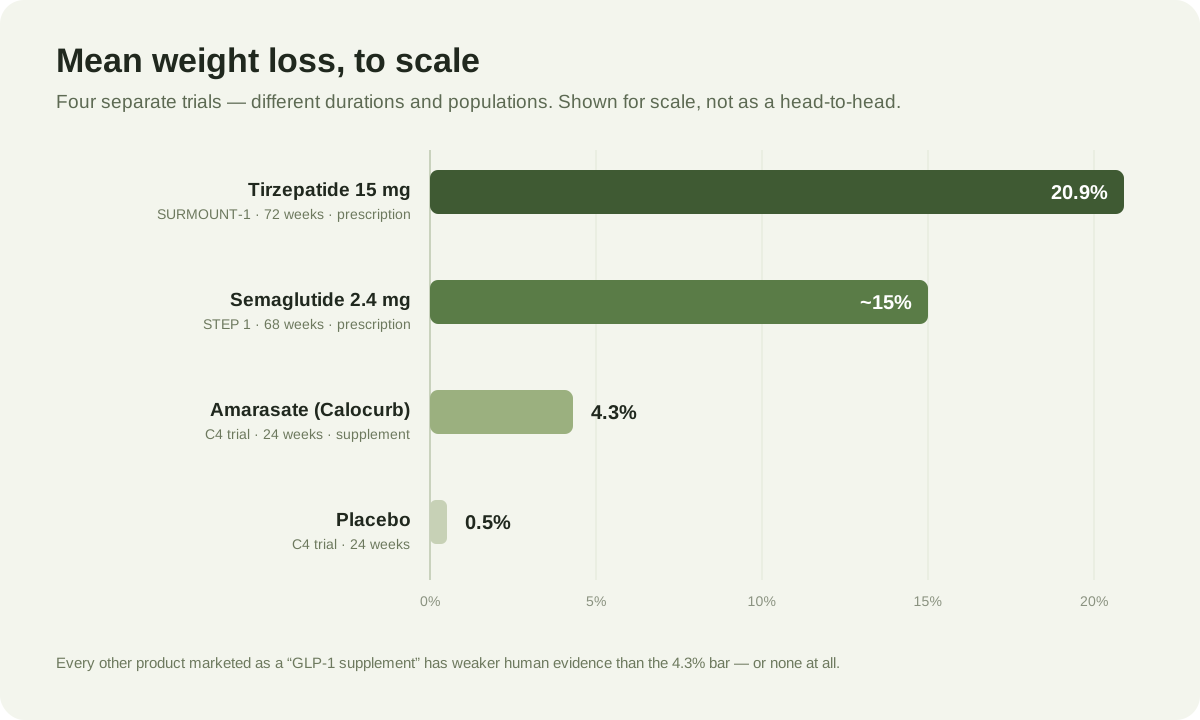
One supplement in this category has real randomised human evidence. It produced about a quarter of the weight loss the drugs produce. Everything else in the aisle is weaker than that, and several products have no human data at all.

Three different things share one name
Almost every argument about GLP-1 is a confusion between three separate things that ended up sharing a label.
The first is a hormone your gut has made your whole life. The second is a class of prescription drugs built to imitate it, which produced the largest weight losses ever recorded outside surgery. The third is a supplement category that grew up around the name, ranging from products with genuine randomised trials to products with no plausible mechanism at all.
This page takes them in turn, with every figure traced to a named trial or regulator. It is written for anyone deciding whether to ask a doctor about these drugs, anyone already on one, and anyone holding a bottle labelled "GLP-1 support" and wondering what it can actually do.
Nothing here is medical advice, and this site neither sells nor prescribes these medicines. Where the honest answer is "nobody knows yet", it says so.
The hormone: what GLP-1 is and what it does
Glucagon-like peptide-1 is an incretin — a hormone released from the gut when food arrives, telling the rest of the body about it. It is produced mainly by L-cells concentrated in the lower small intestine and colon, within minutes of eating.
It does four things that matter here. It stimulates insulin secretion, but only when blood glucose is already elevated, which is why it lowers glucose without insulin's hypoglycaemia risk. It suppresses glucagon, the hormone telling the liver to release stored glucose. It slows gastric emptying, so food leaves the stomach more gradually. And it acts on appetite centres in the brain, producing the sensation of having had enough.
The catch — and the reason the entire drug class exists — is duration. Native GLP-1 is degraded by an enzyme called DPP-4 within roughly two minutes. As a therapy that is useless: you cannot dose a hormone with a two-minute half-life. Every pharmaceutical advance here has been an answer to that single problem.
Worth holding onto: this is your own physiology. The drugs are not introducing an alien mechanism. They hold open a switch your body already flips several times a day, for a week at a time instead of two minutes. That distinction is also the honest reason a supplement cannot match them — nudging a two-minute hormone slightly higher is a different kind of intervention from sustaining the signal for days.
The drugs: what they are and what the trials found
Two molecules dominate, sold under four names, which causes constant confusion.
Semaglutide is a GLP-1 receptor agonist, sold as Ozempic for type 2 diabetes, Wegovy for weight management, and Rybelsus as an oral tablet. Tirzepatide is a dual agonist activating both the GLP-1 and GIP receptors, sold as Mounjaro for diabetes and Zepbound for weight management. Same molecule, different brand, different licensed indication and dosing.
In STEP 1, semaglutide 2.4 mg weekly produced a mean weight reduction of about 15 per cent over 68 weeks. In SURMOUNT-1, tirzepatide 15 mg produced 20.9 per cent over 72 weeks. For scale: weight-loss drugs before this class typically delivered 3 to 8 per cent.
In 2025 the two were compared directly. SURMOUNT-5 randomised adults with obesity and without diabetes to the maximum tolerated dose of either drug for 72 weeks and found tirzepatide superior on both weight reduction and waist circumference.
Weight is not the only endpoint that moved. SELECT enrolled 17,604 people aged 45 or over with existing cardiovascular disease, a BMI of 27 or higher and no diabetes. Semaglutide cut major adverse cardiovascular events — cardiovascular death, non-fatal heart attack, non-fatal stroke — from 8.0 to 6.5 per cent, a 20 per cent relative reduction. That is a hard clinical outcome rather than a surrogate marker, and it is what moved these drugs from cosmetic to cardiometabolic in most clinicians' minds.
What they cost you: side effects, honestly
Side effects are common, mostly gastrointestinal, and usually worst while the dose is being escalated.
From the Wegovy 2.4 mg adult trials: nausea in 44 per cent, diarrhoea in 30 per cent, vomiting in 24 per cent, constipation in 24 per cent — against 16, 16, 6 and 11 per cent on placebo. Headache affected 14 per cent, fatigue 11 per cent, dyspepsia 9 per cent, dizziness 8 per cent. These are not rare inconveniences. They are the experience of a large fraction of everyone taking the drug.
The serious concerns deserve naming precisely rather than either dismissing or sensationalising:
- Thyroid C-cell tumours. The label carries a boxed warning. Semaglutide caused these tumours in rodents at clinically relevant exposures; human relevance is unknown. Contraindicated in anyone with a personal or family history of medullary thyroid carcinoma, or with MEN 2.
- Pancreatitis. Acute pancreatitis, including fatal cases, has been reported with this class. In a two-year trial the rates were similar between semaglutide and placebo — 8 cases against 10 — so the signal is not clear-cut, but it stays on the label.
- Gallbladder disease. Around 1.6 per cent on the 2.4 mg dose. Rapid weight loss of any kind raises gallstone risk.
- NAION. In 2025 the EMA's safety committee concluded that non-arteritic anterior ischaemic optic neuropathy — sudden, usually irreversible vision loss in one eye — is a very rare side effect of semaglutide, up to 1 in 10,000 users. The WHO issued a global alert. Sudden vision change means contacting a doctor immediately.
Keep the rare risks in proportion. One in 10,000 is genuinely very rare, and the cardiovascular benefit in SELECT was measured in whole percentage points across 17,604 people. But "very rare" is not "never", and someone who cannot tolerate persistent nausea is having the single most common reaction to the drug, not failing at it.
The muscle question
In the STEP 1 body composition sub-study, roughly 39 to 40 per cent of the weight lost was lean mass, with absolute lean mass falling about 9.7 per cent. Headlines have run with that figure alone, which is misleading — losing some lean tissue is a normal part of losing any substantial amount of weight, by any method including diet alone.
The fuller picture is that the proportion of lean mass to total body mass increased, and the lean-to-fat ratio improved from 1.34 at baseline to 1.57 at week 68. Body composition improved overall even as absolute muscle fell. Both statements are true, and quoting either alone produces a distorted article.
What follows practically is not controversial. If appetite is suppressed by a third, every remaining mouthful has to work harder, and protein is the macronutrient with the clearest role in defending lean tissue during weight loss. Resistance training is the other half — the signal that tells the body to keep the muscle it has. Our whey protein evidence page covers what protein does and does not do.
Stopping: the finding nobody puts on a billboard
The STEP 1 trial extension followed participants for a year after treatment ended. Having reached a mean 17.3 per cent weight loss at 68 weeks, they regained a mean of 11.6 percentage points over the next 52 weeks — roughly two-thirds of everything lost. Blood pressure returned to baseline. Most lipid markers and C-reactive protein rose substantially. A small relative HbA1c improvement persisted, and 48.2 per cent remained at least 5 per cent below their starting weight.
That is not a scandal and not a reason to avoid the drugs. It is how a treatment for a chronic relapsing condition behaves — blood pressure medication stops working when you stop taking it too. But it reframes the decision from "how much will I lose" to "what does the next decade look like", which is a question about cost, access and tolerability.
The supplement aisle, graded honestly
This is the part this site exists for, and it is more interesting than either the promoters or the debunkers usually allow. The category is not uniformly worthless — but it is wildly uneven, and the differences are not visible from the packaging.
The one with real human trials: Amarasate
Amarasate is a bitter hops extract developed in New Zealand and sold as Calocurb. The mechanism is unusual and plausible: an enteric-coated capsule carries the bitter compounds past the stomach into the small intestine, where bitter taste receptors — the same family found on the tongue — trigger release of GLP-1, CCK and PYY.
Unlike almost everything else in this aisle, it has been tested in people. Early trials were small: 30 fasted men in 2019, 19 healthy-weight men in 2022, 30 women in 2024, reporting 25 to 40 per cent reductions in hunger and cravings and 14 to 18 per cent reductions in energy intake. Then a 24-week double-blind placebo-controlled trial of 150 adults with a BMI of 25 to 35, reported in Obesity Pillars in July 2026, found participants lost 3.77 kg against 0.40 kg on placebo, with lean mass preserved.
Two caveats matter. The research programme originates with the New Zealand institute that developed the extract and licenses it commercially, which is a real interest to declare. And the comparison that puts it in perspective: 3.77 kg over 24 weeks is roughly a quarter of what the drugs deliver. It is a genuine effect at a much smaller scale — which is a far more useful description than either "natural Ozempic" or "snake oil".
The probiotics: a real trial, for a different outcome
Products built on Akkermansia muciniphila and butyrate-producing strains are the second-biggest segment. The logic is sound: butyrate stimulates L-cells to release GLP-1.
Pendulum, the best-known, does have a published human trial in BMJ Open Diabetes Research & Care — a 0.6 per cent HbA1c reduction and 33 per cent smaller post-meal glucose spikes at 12 weeks in type 2 diabetes. That is a real result. It is also a glycaemic result, not a weight-loss one. The health journalism watchdog Gary Schwitzer has specifically noted that the company's GLP-1 claims rest on preclinical studies rather than studies in people — a distinction the marketing does not make.
The fibre drinks: mechanism yes, magnitude no
Prebiotic fibre products are the third segment, and the mechanism is the best documented of any of them. Fermentable fibre reaches the colon, gut bacteria ferment it into short-chain fatty acids — acetate, propionate, butyrate — and those activate FFAR2 and FFAR3 receptors on L-cells, releasing GLP-1. Propionate is the most potent.
The magnitude is where it falls down. A 2026 scoping review pooled 52 studies in 1,085 participants and found the results mixed: only certain fibre types raised GLP-1 consistently, and — the part that matters — studies reporting a GLP-1 increase showed only a non-significant tendency to also report increased satiety, with a confidence interval including the null. Raising the hormone on a blood test did not reliably translate into eating less.
Berberine, and the rest of the shelf
Berberine gets called "nature's Ozempic", mostly by social media. It is a plant alkaloid acting through the AMPK enzyme — mechanistically closer to metformin than to semaglutide, and not acting on the GLP-1 receptor at all. Small trials at around 1 g daily report modest reductions in weight and waist circumference; UCLA Health's summary is that the amount you can lose is unclear. It can potentiate diabetes medicines, interacts with anti-rejection drugs, and is harmful to infants.
Below that sits the bulk of the category: apple cider vinegar and BHB "keto" blends relabelled as GLP-1 boosters, and proprietary formulas that will not say how much of anything is in them. We have reviewed products of that shape — one disclosed dose out of five, a twelve-ingredient proprietary blend with no amounts at all. Where a product will not tell you the quantities, no discussion of mechanism is possible, and the "GLP-1" on the label is doing marketing work rather than describing the formula.
Compounded and counterfeit versions
A grey market grew alongside the shortages, and the regulator's language about it is unusually direct.
The FDA states that compounded GLP-1 drugs are unapproved products that do not undergo review for safety, effectiveness or quality before marketing. As of 31 May 2026 it had received 990 adverse event reports associated with compounded semaglutide and more than 730 for compounded tirzepatide. A recurring cause is ten-fold dosing errors from confusion over syringe units — by patients and sometimes by clinicians.
It has also flagged counterfeit Ozempic that may contain the wrong ingredient, too much, too little or none; "semaglutide sodium" and "semaglutide acetate" salt forms that are different active ingredients with no safety data; products sold with dosing instructions while labelled "for research purposes" or "not for human consumption"; and improper refrigeration in transit. Its advice is simple: a prescription from a licensed prescriber, filled at a licensed pharmacy, and multi-dose vials discarded 28 days after first use.
Access varies enormously by country
Where you live changes this decision more than almost anything else. In the United States both semaglutide and tirzepatide are FDA-approved for weight management, and the binding constraint is insurance coverage and out-of-pocket cost. Across the European Union the EMA has authorised the same molecules, with national reimbursement rules differing widely between member states.
In England, NICE recommends tirzepatide for adults with a BMI of at least 35 and one weight-related condition, and semaglutide from a BMI of 30 with a weight-related condition, with thresholds reduced by 2.5 kg/m² for people from some minority ethnic backgrounds; NHS primary care prescribing of tirzepatide began a phased rollout on 23 June 2025 from the highest-need group. In much of Asia, Latin America and Africa, access is largely private-pay where it exists at all, and the counterfeit risk described above is correspondingly higher.
The practical point for an international reader: the trial results are the same everywhere, and the cost, eligibility and supply chain are not. Check your own country's regulator rather than assuming a headline from elsewhere applies.
So what should you actually do?
If you are considering a prescription: that conversation is with a doctor. Useful questions are what the side-effect profile means for your life, what happens when you stop, what it costs over years rather than months, and whether you are eligible under your country's rules. Do not buy from a site that does not require a prescription.
If you are already taking one: protein intake and resistance training are the two things most within your control, for the lean mass reason above. Constipation affects around a quarter of users and responds to fibre and fluid — raise fibre gradually and mention it to your prescriber, since these drugs already slow gastric emptying.
If you are looking at a supplement: read the panel first. If it will not tell you how much of each ingredient it contains, stop there. If it will, then ask what human evidence exists for that specific ingredient at that specific amount — and note that "clinically studied" frequently refers to a trial at a different dose, in a different population, or measuring something other than weight.
The products below are the best-known things sold in this category. They are listed because people are buying them and deserve an accurate account of what is behind each one, not because any of them replaces a prescription. None has been reviewed and scored here yet, and each card says so.
What is actually sold.
The best-known supplements marketed for GLP-1, with what the evidence behind each one supports. None is a substitute for a prescribed medicine, and none has been scored here yet.
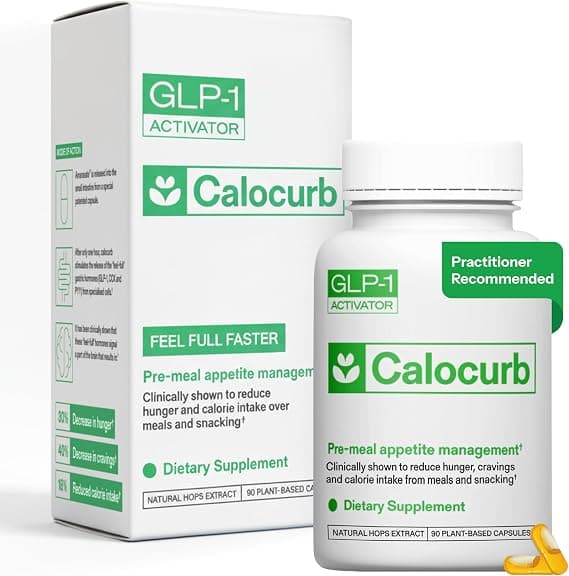
Calocurb (Amarasate bitter hops extract)
Evidence: Randomised human trials, manufacturer-linked
The only product in this category with randomised controlled human evidence measuring both appetite hormones and weight. Amarasate is a bitter hops extract in an enteric-coated capsule, designed to reach the small intestine and trigger bitter taste receptors that release GLP-1, CCK and PYY. In a 24-week double-blind placebo-controlled trial of 150 adults with a BMI of 25 to 35, reported in Obesity Pillars in July 2026, participants lost 3.77 kg against 0.40 kg on placebo, with lean mass preserved. Read that with two caveats: the earlier trials were small (19 to 30 people) and the research programme originates with the New Zealand institute that developed and licenses the extract. It is also roughly a quarter of what the drugs achieve.
Read the full reviewAffiliate link: we may earn a commission at no extra cost to you.
Check the current price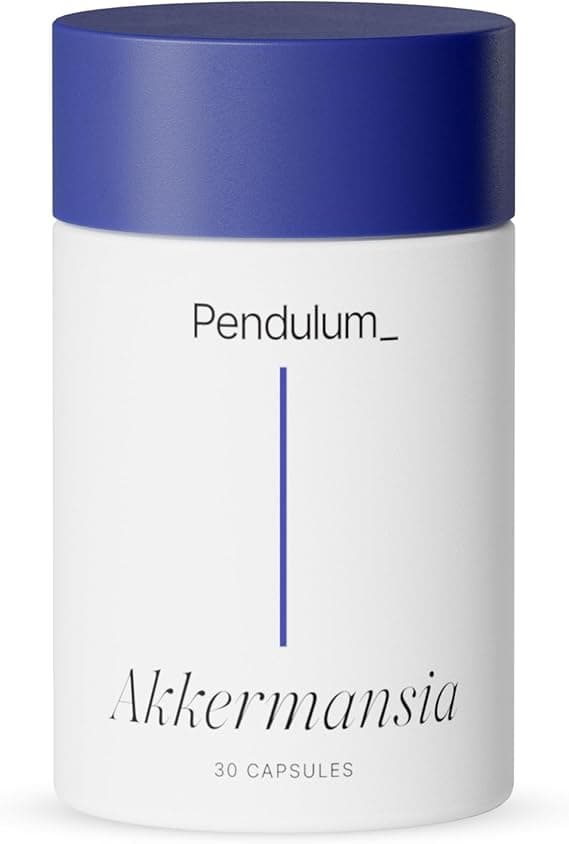
GLP-1 Probiotic (Akkermansia muciniphila)
Evidence: Human trial for blood glucose; GLP-1 claim preclinical
The best-known probiotic sold for GLP-1, built on Akkermansia muciniphila plus butyrate-producing strains — the idea being that butyrate stimulates L-cells to release GLP-1. Pendulum does have a published human trial in BMJ Open Diabetes Research & Care, but its endpoints were glycaemic: a 0.6 per cent HbA1c reduction and 33 per cent smaller post-meal glucose spikes in type 2 diabetes at 12 weeks. That is a real result for a real outcome. It is not weight loss, and the health journalism watchdog Gary Schwitzer has pointed out that the company’s GLP-1 claims specifically rest on preclinical studies rather than studies in people.
Not yet reviewed or scored on this site.
Affiliate link: we may earn a commission at no extra cost to you.
Check the current price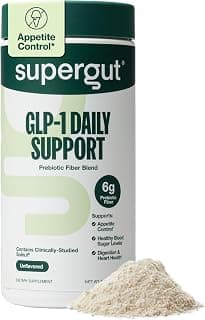
GLP-1 Booster prebiotic fibre blend
Evidence: Mechanism established; effect on appetite inconsistent
A prebiotic fibre drink built on resistant starch and other fermentable fibres. The mechanism is genuinely well documented: fermentable fibre reaches the colon, gut bacteria convert it to short-chain fatty acids, and those activate receptors on L-cells that release GLP-1. The problem is magnitude. A 2026 scoping review pooling 52 studies in 1,085 participants found only some fibre types raised GLP-1 consistently, and studies showing a GLP-1 rise had only a non-significant tendency to also report increased satiety. Worth eating as fibre. Not a drug, and priced well above plain psyllium.
Not yet reviewed or scored on this site.
Affiliate link: we may earn a commission at no extra cost to you.
Check the current priceYour questions
What does GLP-1 actually stand for?
Glucagon-like peptide-1. It is an incretin hormone released by L-cells in your gut wall after eating. It prompts insulin release when blood glucose is high, suppresses glucagon, slows how fast the stomach empties, and signals fullness to the brain. Your own GLP-1 is destroyed by an enzyme called DPP-4 within about two minutes. The drugs are engineered to resist that and last for days.
Do any GLP-1 supplements actually work?
One has randomised human evidence worth taking seriously. Amarasate, the bitter hops extract sold as Calocurb, produced 3.77 kg of weight loss over 24 weeks against 0.40 kg on placebo in a 150-person double-blind trial. That is real — and it is roughly a quarter of what semaglutide or tirzepatide achieve. Most other products in the category rest on mechanism, preclinical work or trials in a different outcome entirely, and some have no GLP-1 mechanism at all.
Is berberine "nature’s Ozempic"?
No, and the nickname is misleading about the mechanism rather than just the magnitude. Berberine is a plant alkaloid that acts mainly through the AMPK enzyme — closer to how metformin behaves than how semaglutide does. It does not act on the GLP-1 receptor. Trials in people with a BMI of 25 to 29.9 taking about 1 g daily for eight weeks or more have reported modest reductions in weight and waist circumference, but they are small and, as UCLA Health puts it, the amount of weight you can lose is unclear. It can also potentiate diabetes medicines and interacts with anti-rejection drugs.
How much weight do people lose on the prescription drugs?
In STEP 1, semaglutide 2.4 mg produced a mean reduction of about 15 per cent over 68 weeks. In SURMOUNT-1, tirzepatide 15 mg produced 20.9 per cent over 72 weeks. SURMOUNT-5 compared them directly in adults with obesity and without diabetes and found tirzepatide superior on both weight and waist circumference. These are trial averages with regular clinical contact and lifestyle support, not guarantees.
What happens if I stop?
Most of the weight returns. In the STEP 1 extension, participants who had lost 17.3 per cent regained a mean of 11.6 percentage points within a year of stopping — roughly two-thirds — and blood pressure and most lipid markers drifted back toward baseline. Just under half were still at least 5 per cent below their starting weight after that year. These are treatments for a chronic condition rather than a course you finish.
Do the drugs cause muscle loss?
They cause lean mass loss, as any large weight loss does. In the STEP 1 body composition sub-study around 39 to 40 per cent of weight lost was lean tissue, with absolute lean mass down about 9.7 per cent. The fuller picture is that the ratio of lean to fat mass still improved, from 1.34 to 1.57, so body composition got better even as absolute muscle fell. Protein intake and resistance training are the recognised ways to protect the lean side.
What are the main side effects?
Mostly gastrointestinal and common. In the Wegovy 2.4 mg trials: nausea 44 per cent, diarrhoea 30 per cent, vomiting 24 per cent, constipation 24 per cent, against 16, 16, 6 and 11 per cent on placebo. Serious but rarer concerns include pancreatitis and gallbladder disease, and the label carries a boxed warning about thyroid C-cell tumours seen in rodents. In 2025 the EMA classified NAION — a sudden, usually irreversible vision loss — as a very rare side effect of semaglutide, up to 1 in 10,000 users, and the WHO issued an alert.
Are compounded or online GLP-1 products safe?
The FDA has been unusually blunt. Compounded versions are not reviewed for safety, effectiveness or quality, and as of 31 May 2026 the agency had logged 990 adverse event reports involving compounded semaglutide and more than 730 involving compounded tirzepatide. A recurring cause is ten-fold dosing errors from confusion over syringe units. It has also warned about counterfeit products, "semaglutide sodium" and "semaglutide acetate" salt forms that are different active ingredients with no safety data, and products sold with dosing instructions while labelled "for research purposes".
Can a supplement replace the injection?
No, and the gap is one of kind rather than degree. A drug that holds GLP-1 signalling open for a week is doing something structurally different from a capsule that nudges your own two-minute hormone. The best supplement evidence in this category is about a quarter of the drug effect, from smaller and shorter trials. If you qualify for a prescription and want the results the trials showed, a supplement is not the route to them.
References
- Wilding JPH et al. (2021). Once-weekly semaglutide in adults with overweight or obesity. STEP 1 — mean weight reduction of about 15 per cent over 68 weeks, and the body composition sub-study behind the lean mass figures.
- Wilding JPH et al. (2022). Weight regain and cardiometabolic effects after withdrawal of semaglutide: the STEP 1 trial extension. Diabetes, Obesity and Metabolism — a mean 11.6 percentage points regained over 52 weeks off treatment.
- Jastreboff AM et al. (2022). Tirzepatide once weekly for the treatment of obesity. SURMOUNT-1 — 20.9 per cent mean weight reduction on 15 mg at 72 weeks.
- Aronne LJ et al. (2025). Tirzepatide as compared with semaglutide for the treatment of obesity. SURMOUNT-5 — head-to-head at maximum tolerated dose over 72 weeks.
- Lincoff AM et al. (2023). Semaglutide and cardiovascular outcomes in obesity without diabetes. SELECT — 17,604 participants, major adverse cardiovascular events 6.5 per cent against 8.0 per cent on placebo.
- US Food and Drug Administration. WEGOVY (semaglutide) injection prescribing information — the boxed warning on thyroid C-cell tumours, the contraindications, and the adverse reaction rates quoted on this page.
- World Health Organization (27 June 2025). The use of semaglutide medicines and risk of non-arteritic anterior ischemic optic neuropathy (NAION) — the EMA PRAC conclusion that NAION is a very rare side effect, up to 1 in 10,000 users.
- US Food and Drug Administration. FDA’s concerns with unapproved GLP-1 drugs used for weight loss — dosing errors, salt forms, counterfeits, research-use-only labelling, and the advice to use a licensed prescriber and pharmacy.
- Neeland IJ et al. (2024). Changes in lean body mass with glucagon-like peptide-1-based therapies and mitigation strategies. Diabetes, Obesity and Metabolism — context for the proportion of weight lost as lean tissue and what protein and resistance training do about it.
- Dietary fibers to boost endogenous GLP-1 secretion and satiety: a scoping review (2026). Frontiers in Endocrinology — 52 studies, 1,085 participants; GLP-1 rises showed only a non-significant tendency toward increased satiety.
- Amarasate — overview of the bitter hops extract and its published human trials, including the 24-week C4 trial of 150 adults reported in Obesity Pillars in July 2026. We were unable to open the paper itself; the trial figures here come from the institute and trade reporting of it.
- Perraudeau F et al. Improvements to postprandial glucose control in subjects with type 2 diabetes: a multicenter, double-blind, randomized trial of a novel probiotic formulation. BMJ Open Diabetes Research & Care — the human trial behind Pendulum, with glycaemic rather than weight endpoints.
- Schwitzer G. Analysis of celebrity-endorsed GLP-1 probiotic marketing — notes that the company’s GLP-1 claims rest on preclinical studies rather than studies in people.
- UCLA Health. What to know about berberine, the so-called “nature’s Ozempic” — the AMPK mechanism, the limited trial evidence, and the drug interactions.
- National Institute for Health and Care Excellence. Tirzepatide for managing overweight and obesity (TA1026) — the BMI thresholds and phased NHS rollout cited in the access section.
Page history
- Corrected an overstatement in the first draft. It said nothing sold as a supplement comes close to the drugs, which is too absolute: Amarasate has randomised human trials measuring appetite hormones and weight, reporting 3.77 kg against 0.40 kg on placebo over 24 weeks. The page now reports that alongside its limitations — small earlier trials, a manufacturer-linked research programme, and an effect roughly a quarter the size of the drugs.
- Rewritten for an international readership and re-researched from primary sources. The earlier draft treated the UK as the default and recommended protein and vitamin D; access by country is now one section among several, and the product block carries supplements actually marketed for GLP-1. Added a contents sidebar, a to-scale figure comparing the trial results, and the full source list below.
- First published.