SlimSet review
A one-capsule-a-day weight management supplement sold direct from its own sales page. Five ingredients are named; exactly one has an amount attached, and it is the caffeine. That single fact decides most of this review.

Our take: the one number on the page is the wrong one
SlimSet is a single-capsule daily supplement sold directly from its own sales page, aimed squarely at women who feel their metabolism has slowed. The headline is “The Metabolism Support Formula Women Are Talking About”, and the pitch underneath is appetite regulation, fewer cravings and steadier energy.
Five ingredients are named: green coffee bean extract, garcinia extract, green tea extract, raspberry ketone and caffeine anhydrous. Exactly one of them has a quantity attached anywhere on the page — 138 mg of caffeine anhydrous per capsule. The four ingredients the product’s claims actually rest on are named without amounts.
That is the whole review in miniature. A supplement is a dose before it is anything else, and a reader cannot compare an undisclosed amount against the research. What we can say with confidence is that a capsule containing 138 mg of caffeine will do what 138 mg of caffeine does, and that this is the one thing on the label a buyer can check.
This is a desk review of a sales page and published research. Nobody here has bought, taken or tested this product, and no independent listing exists to cross-check the page against, because the company states it is sold exclusively through its own website.
What the page actually discloses
The directions are one vegetable capsule daily with a full glass of water, roughly 30 minutes before breakfast. A bottle is 30 capsules, which the page presents as a one-month supply. The FAQ suggests allowing “60–90 days of consistent daily use”, which is the reason the six-bottle pack exists.
Here is the disclosure, exactly as the page presents it. Green Coffee Bean Extract is “standardized to 50% chlorogenic acids”. Garcinia Extract is “standardized to 50% HCA (hydroxycitric acid)”. Green Tea Extract is “standardized to 98% polyphenols and 45% EGCG”. Raspberry Ketone and Caffeine Anhydrous are listed without standardisation, the caffeine at 138 mg per capsule.
Those percentages look like precision and are not. A standardisation figure tells you how concentrated an extract is, not how much of it you are getting — 50 per cent HCA is a property of the raw material, and it says nothing at all until you know how many milligrams of that material are in the capsule. Four numbers that appear to be doses are in fact four numbers that cannot become doses without a fifth number the page does not print.
To the company’s credit, there is no proprietary blend declared, and the caffeine figure is stated plainly rather than buried. But a product with no readable Supplement Facts panel at all is in a weaker position than one that hides its amounts inside a blend, because at least a blend discloses a total.
The arithmetic problem with one capsule
There is a limit to how generous you can be here, and it is physical. A single vegetable capsule of the sizes used for supplements holds a few hundred milligrams of powder in total. The disclosed caffeine already accounts for 138 mg of whatever that figure is.
Now consider what would have to fit in the remainder. The trials behind garcinia use hydroxycitric acid measured in grams per day rather than milligrams, and at 50 per cent HCA you need two grams of extract for every gram of HCA. Green tea catechin research works with EGCG in the hundreds of milligrams, which at 45 per cent EGCG again implies several hundred milligrams of extract on its own. Green coffee chlorogenic acid research sits in a similar range.
Any one of those, at the amount the research used, would fill the capsule by itself — and there are four ingredients plus 138 mg of caffeine to fit in. We are not claiming to know what is in this product, because the page does not say. We are pointing out that no combination of undisclosed amounts resolves this, and that a one-a-day capsule is a format decision that constrains the answer before the formulation begins.
This is why the dose score here is a 2 rather than a 5. It is not that the amounts are too small. It is that they are unknowable, and the format makes the optimistic reading implausible.
What the four ingredients are actually credited with
Take the claims one at a time, because they are not equally weak.
Green tea extract is the best documented of the four, and our green tea extract evidence page grades it C for weight loss and C for raising metabolic rate. The NIH position is that it might help with a small amount of weight loss — phrasing that is doing careful work, because the effect is small and the results inconsistent. The page here describes it as supporting “thermogenesis — the body’s natural calorie-burning process”, which is a fair description of a measurable short-term effect and an unfair implication about the scale.
Green coffee bean extract and garcinia both carry limited evidence for weight loss, with small early signals that larger and better-designed trials have not built on. The page describes garcinia as “supporting healthy satiety signals and helping curb the constant pull toward sugar and carbs”, which is a considerably more confident sentence than the literature supports.
Raspberry ketone is the weakest of the set by a distance. The page says it “plays a role in supporting the breakdown of stored fat — particularly the kind that settles around the midsection”. We could find no human trial establishing that; the marketing for this compound rests on laboratory and animal work, and spot reduction of abdominal fat by a supplement is not an established phenomenon at all.
Caffeine is the ingredient that does something, and the page is accurate about it: alertness, energy, a contribution to thermogenesis. At 138 mg a capsule that is roughly a strong cup of coffee. If you take this product and feel a difference in the first week, caffeine is much the most likely explanation — and that feeling is not evidence the other four ingredients are working.
Price, and a number that does not reconcile
Three packages are offered. One bottle is $89, reduced from $99, plus shipping. Three bottles are $177, billed as $59 a bottle, reduced from $447. Six bottles are $294, billed as $49 a bottle, reduced from $894, with free US shipping. The page does not print a shipping figure for the smaller packs, so the per-day costs below exclude it.
That works out at $2.97 a day for a single bottle, $1.97 a day across three, and $1.63 a day across six. The cheapest rate requires buying six months in advance, which the FAQ recommends twice and which a banner attributes to “94% of Customers” — a statistic with no source attached.
The part worth checking is the savings maths. The one-bottle offer sets the regular price at $99. But the three-bottle “was” price of $447 works out at $149 a bottle, and the six-bottle “was” price of $894 works out at $149 a bottle as well. The same bottle therefore has a regular price of $99 or $149 depending on which package is being sold to you. Both figures cannot be right, and the larger one is the one used to generate the “You Save $600!” headline.
Against that, what is quantified in the bottle is 138 mg of caffeine a day. Caffeine costs almost nothing in any form, and green tea extract and green coffee extract are inexpensive commodity ingredients sold openly with their amounts printed. You may be paying for more than that here; the page simply does not let you find out.
Safety: the disclosed risk and the undisclosed one
The page handles the stimulant responsibly, which is worth saying in a category that often does not. It states the caffeine amount, and it says the product is “not recommended for individuals who are pregnant, nursing, under 18, sensitive to stimulants, or managing a heart condition or high blood pressure without medical supervision”. That is a reasonable and specific warning.
The number to watch is your total caffeine. 138 mg from a capsule taken before breakfast sits on top of whatever coffee, tea or energy drink follows it, and the capsule is the one source you will not notice. Anyone who has trouble with sleep, anxiety, palpitations or blood pressure should count all of it.
The undisclosed risk is the green tea extract. Concentrated green tea extract has been linked to liver injury in some people — a risk that does not apply to drinking tea, and one that depends on how much EGCG is in the capsule. Because the amount is not published, a buyer cannot judge their exposure, and neither can we. Our evidence page for the ingredient sets out what is known.
The page states the product is made in an FDA-registered, GMP-certified facility in the USA. That describes manufacturing conditions and registration, not an assessment of the product: the FDA does not approve dietary supplements for safety or effectiveness before sale, and “FDA-registered facility” is frequently read as though it did. No third-party testing or batch certificate is mentioned anywhere on the page.
The guarantee, and what it does and does not say
A 60-day money-back guarantee is offered, in unusually warm language: “let us know any time within the next 60 days and we’ll refund every single penny of your investment. No hoops, no questions asked.” The FAQ repeats it as “simply contact our customer support team and we’ll refund your full purchase — no questions asked.”
What the page does not state is the mechanics, and the mechanics are where refunds usually go wrong. It does not say whether bottles must be returned, who pays return postage, whether opened bottles qualify, or whether the 60 days run from the order date or from delivery. On a six-bottle order that is 180 days of product bought against a 60-day window, so the terms matter more than the headline number does.
The page also states there are “no hidden charges, subscriptions, or automatic re-bills”, which is a meaningful commitment in a category where rebilling is a common complaint. Get the refund conditions in writing from customer support before ordering a multi-bottle pack, and keep the reply.
Sources and shopping: what to ask before you order
If you are considering this, ask the company for one thing: a photograph of the Supplement Facts panel showing the milligram amount of every ingredient. That is not an unreasonable request — it is printed on the bottle, it is a legal requirement on the label, and it is the single piece of information that would let you judge the product. If it is supplied, compare the green tea extract and garcinia amounts against the research before deciding.
Ask the refund questions in the same message: returns required or not, who pays postage, opened bottles, and when the 60 days start. Then decide whether the six-bottle recommendation still appeals.
Our commercial link is our SlimSet link. It earns a commission at no extra cost to you and has no bearing on the 2.8 above, which is what the five published criteria produce when four of five ingredient amounts are missing. For a weight-management product with a single, fully disclosed active and published research behind it, the ColonBroom review is a more useful comparison than it may first appear — not because it scores well, but because you can at least check what is in it.
The fair summary: caffeine and green tea extract are real ingredients with real, modest effects, and there is nothing inherently wrong with a product built on them. What we cannot endorse is buying four of them blind, at $2.97 a day, on the strength of percentages that are not doses.
Ingredient analysis
Caffeine anhydrous
moderate evidenceThe only disclosed amount in the formula, and roughly a strong cup of coffee. Caffeine genuinely does increase alertness and energy expenditure in the short term, with tolerance developing. If you notice anything from this product in the first week, this is the likeliest cause. Count it alongside every other caffeine source in your day.
Green tea extract (98% polyphenols, 45% EGCG)
weak evidenceThe best-evidenced of the four non-stimulant ingredients, and still graded C for weight loss on our evidence page — the NIH position is that it might help with a small amount. The standardisation figure tells you the concentration, not the quantity. The missing amount also makes the liver-injury risk associated with concentrated extract impossible to judge.
Full evidence on Green tea extractGreen coffee bean extract (50% chlorogenic acids)
weak evidenceEvidence for weight loss is limited: small early signals that larger, better-designed trials have not built on. Described on the page as supporting how the body processes glucose and stored fat, which is a mechanistic statement rather than an outcome.
Garcinia extract (50% HCA)
weak evidenceCredited on the page with satiety and curbing sugar cravings. The evidence is limited, and the trials behind it use hydroxycitric acid in gram quantities per day — an amount that cannot coexist with four other ingredients in a single daily capsule.
Raspberry ketone
none evidenceThe weakest ingredient here. The page says it supports the breakdown of stored fat, “particularly the kind that settles around the midsection”. We could find no human trial establishing that, and targeted reduction of fat from one body region by a supplement is not an established effect.
Who it’s for. What to consider.
Who it may suit
Honestly, nobody we can identify with confidence from the information published. An adult who wants a low-dose caffeine and green tea capsule, has been shown the full Supplement Facts panel by the company, and has checked the amounts against the research could make an informed decision. That panel is not on the sales page.
Who should avoid it
Anyone pregnant, nursing, under 18, sensitive to stimulants, or managing a heart condition or high blood pressure without medical supervision — the page says so itself. Anyone already drinking coffee who has not counted their total caffeine. Anyone with liver concerns, since the green tea extract amount is not published.
What stands out
The caffeine amount is stated plainly at 138 mg per capsule, which many stimulant products do not do
No proprietary blend is declared, and the ingredients are named individually
The contraindications are specific and include stimulant sensitivity, heart conditions and high blood pressure
A 60-day money-back guarantee is offered, and the page states there are no subscriptions or automatic re-bills
Worth considering
No readable Supplement Facts panel: four of the five ingredients have no amount published anywhere on the page
The only quantified ingredient is the stimulant, not any of the four the weight-management claims rest on
Standardisation percentages are presented where doses should be, which reads as disclosure without being it
The regular price of one bottle is $99 on the single-bottle offer and $149 inside the multi-bottle savings maths
Raspberry ketone is credited with breaking down abdominal fat, a claim we could find no human trial supporting
No third-party testing or batch certificate is mentioned, and the refund mechanics are not stated
Score breakdown
Five criteria, each out of 10, averaged to the overall score. See how we score products.
How does it compare?
A closer look at the alternatives. Compare the ingredients and serving sizes, then explore the full review.
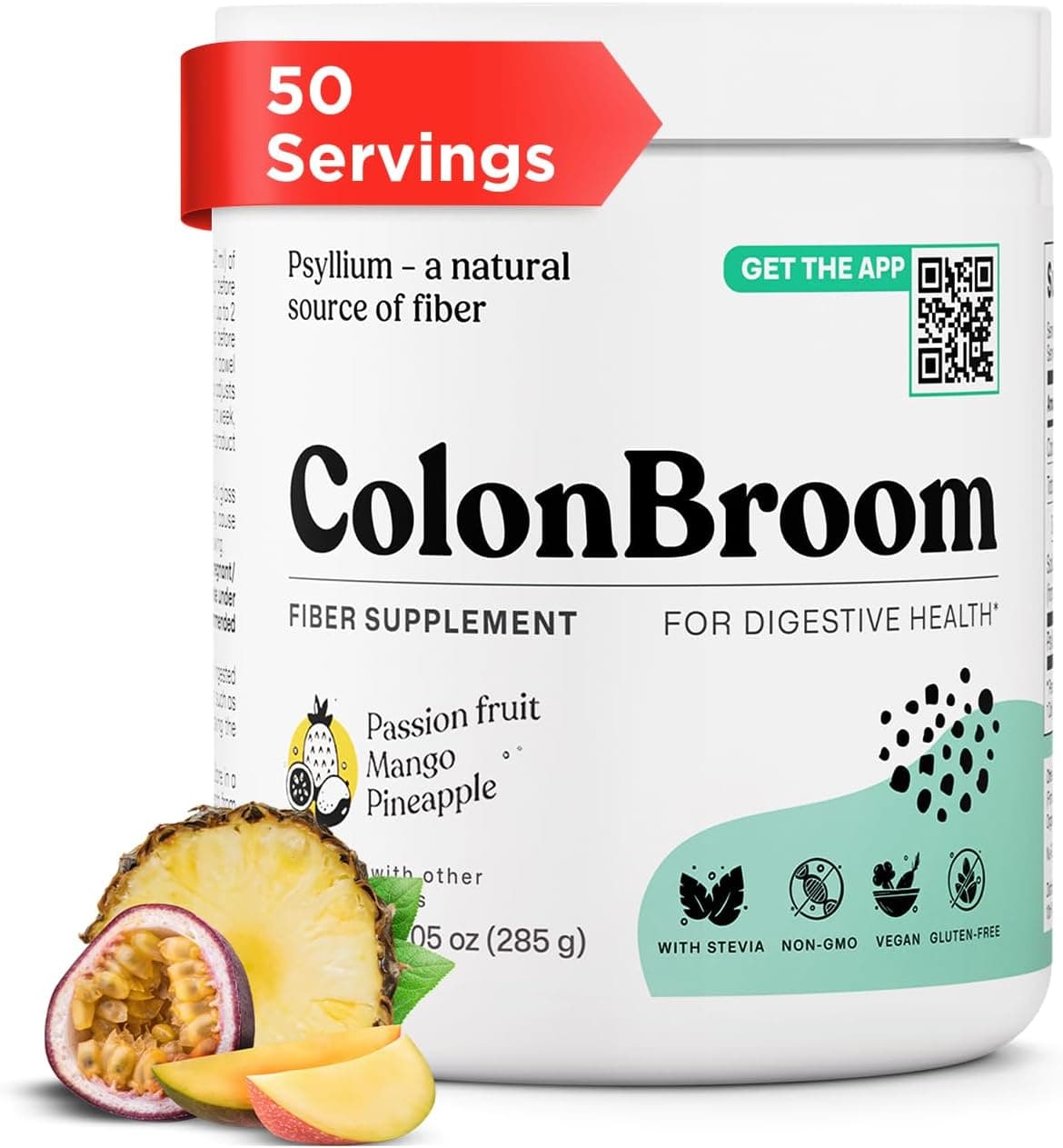
ColonBroom Psyllium Fiber Powder
ColonBroom puts a familiar fibre ingredient into a flavoured daily drink. We look at what psyllium can do, what a serving costs, and the label details to check before you buy.
Affiliate links: we may earn a commission at no extra cost to you. Prices and availability change — check the seller before buying.
Where to buy
Affiliate link: we may earn a commission at no extra cost to you.
Check the current priceYour questions, answered.
Does SlimSet work?
We cannot say, and neither can the sales page, because four of the five ingredient amounts are not published. What is quantified is 138 mg of caffeine per capsule, which will produce the alertness and modest energy-expenditure effects caffeine produces. The four ingredients the weight-management claims rest on range from limited evidence to none in humans, and without amounts none of them can be compared with the research.
What is actually in SlimSet?
Green coffee bean extract standardised to 50 per cent chlorogenic acids, garcinia extract at 50 per cent HCA, green tea extract at 98 per cent polyphenols and 45 per cent EGCG, raspberry ketone, and 138 mg of caffeine anhydrous. Only the caffeine figure is a dose. The percentages describe how concentrated each extract is, not how much of it is in the capsule.
Is 138 mg of caffeine a lot?
It is roughly a strong cup of coffee, taken before breakfast. On its own that is unremarkable for most adults. The issue is that it is invisible: it sits on top of whatever else you drink that day, and it is the one source you will not think to count. Anyone sensitive to stimulants, or managing sleep, anxiety, palpitations or blood pressure, should add it to their daily total rather than treating a capsule as free.
Is SlimSet safe?
The page states it should not be used by anyone pregnant, nursing, under 18, sensitive to stimulants, or managing a heart condition or high blood pressure without medical supervision, which is a reasonable warning. The unresolved question is the green tea extract: concentrated extract has been linked to liver injury in some people, and because the amount is not published, neither you nor we can judge the exposure. Take the label to a pharmacist if you take any regular medicine.
Why does this review score it so low?
Almost entirely because of what is missing rather than what is present. Two of the five published criteria — dose against the studied amount, and label transparency — depend on knowing how much of each ingredient you get, and that information is not on the page. The safety mark is the highest of the five because the caffeine amount and the contraindications are both stated.
Is the 60-day guarantee reliable?
The wording is generous — “no hoops, no questions asked” — but the page does not state the mechanics: whether bottles must be returned, who pays return postage, whether opened bottles qualify, or whether the 60 days run from order or delivery. Ask customer support those four questions in writing before ordering, particularly on a six-bottle pack, which is 180 days of product against a 60-day window.
Why do the “was” prices not match?
Because the page uses two different regular prices for the same bottle. The single-bottle offer is $89 reduced from $99. The three-bottle and six-bottle offers compute their savings from $447 and $894, which are $149 a bottle. Both cannot be the regular price, and the higher figure is the one that produces the larger saving on the banner.
Should I buy the six-bottle pack?
It is the cheapest per day at about $1.63 against $2.97 for a single bottle, and the page recommends it twice. But it asks you to commit to six months of a product whose ingredient amounts you have not seen, against a 60-day refund window whose terms are not stated. If you want to try this, a single bottle costs less to be wrong about.
Community experiences
Reader submissions open once a page is published from the editorial database. This overview is maintained in code, so there is nothing to attach a submission to yet. If you have used this product, send it through the contact page and it will be considered when submissions open.
References
- SlimSet official sales page — the source of every price, claim, ingredient description, direction, warning and guarantee quoted on this page, read on 22 September 2026.
- NIH Office of Dietary Supplements. Dietary Supplements for Weight Loss — Fact Sheet for Consumers. The source for the site’s position on green tea, green coffee bean extract and garcinia for weight loss.
- NIH LiverTox: Clinical and Research Information on Drug-Induced Liver Injury — green tea extract, the basis for the liver-injury caution attached to concentrated extract rather than to tea.
- US Food and Drug Administration. Questions and answers on dietary supplements — supplements are not approved by the FDA for safety or effectiveness before sale, and facility registration is not product approval.
Page history
- All product figures, claims and quotations read from the company’s own sales page on this date. No retailer listing or independent product page exists to cross-check against, because the company states the product is sold exclusively through its own website. No Supplement Facts panel showing milligram amounts could be found; if one is supplied, this page will be updated and the dose and transparency scores revisited.
- First published. Scored 2.8 out of 10 against the five published product criteria. The marks lost are for missing information rather than for any demonstrated problem with the formula: four of five ingredient amounts are not published anywhere on the sales page, which makes the dose and transparency criteria unanswerable. The safety mark is the highest of the five because the caffeine amount and the contraindications are both stated plainly.
Keep asking good questions.
ColonBroom Psyllium Fiber Powder
ColonBroom puts a familiar fibre ingredient into a flavoured daily drink. We look at what psyllium can do, what a serving costs, and the label details to check before you buy.