What happens if you eat two peaches a day for a week?
Mostly small, pleasant changes: a sweet snack for under 60 kcal a peach, a quarter of a day’s vitamin C, extra potassium and water, and a gentle effect on blood sugar. Peaches have less fibre than apples or pears, and some people get wind from their sorbitol. Peaches have almost no trials of their own, so this article says where the evidence comes from.
The short answer
Eat two peaches a day for a week and the changes are mostly small and pleasant. You get a sweet snack for under 60 kcal a peach, about a quarter of a day’s vitamin C, extra potassium and a fair amount of water, with a gentle effect on blood sugar. If they replace biscuits or sweets, that swap is the biggest benefit of the week.
Peaches are not a fibre powerhouse — two give about 4.5 g, half what two pears do — and like many stone fruits they contain sorbitol, which gives some people wind. What a week will not do is change your blood pressure, cholesterol or weight.
One thing to be clear about: peaches have almost no clinical trials of their own. Unlike apples, pears and prunes, nobody has run a good trial of eating peaches every day and measuring the results. So this article works from what peaches contain and from research on whole fruit in general, and says so at each step.
What two peaches a day give you
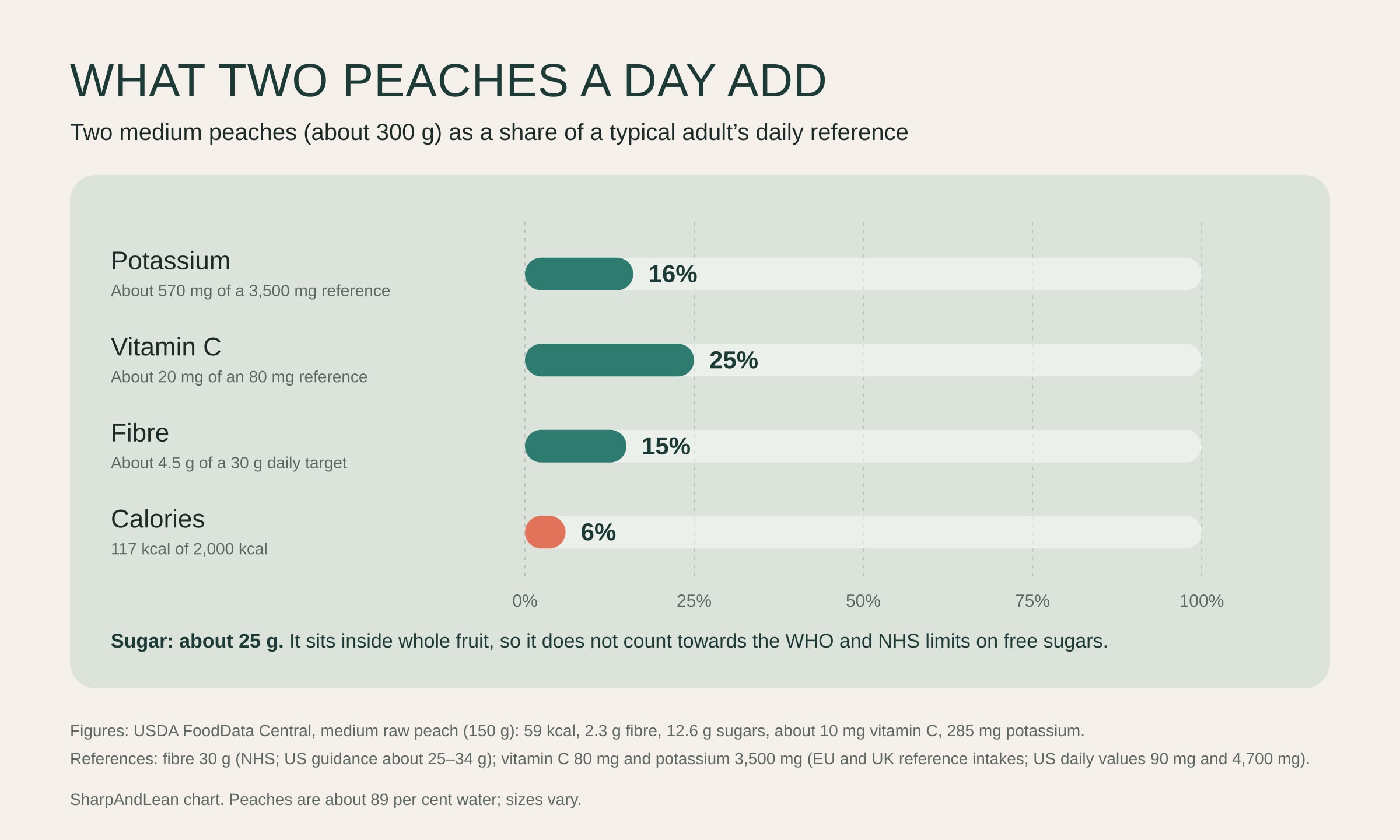
A medium peach weighs about 150 g and has 59 kcal, 14 g of carbohydrate (12.6 g of it natural sugar), 2.3 g of fibre, about 10 mg of vitamin C and 285 mg of potassium, according to USDA FoodData Central. Two peaches double that. Peaches are about 89 per cent water, so two of them also give you roughly a glass of fluid.
The sugar in whole fruit is not the sugar health guidelines warn about: the World Health Organization’s limits on free sugars exclude it. Peaches tinned in syrup are different — the syrup is added sugar.
Day by day: what to expect
| When | What is likely | Why |
|---|---|---|
| Days 1–2 | A sweet, filling snack for few calories. A gentler blood-sugar rise than a biscuit or sweets would give. | Water, fibre and a low glycaemic index. |
| Days 2–4 | For some people, a little more wind or bloating; for most, no noticeable change. | Peaches contain sorbitol, which gut bacteria ferment. |
| Days 5–7 | A habit: higher fruit, vitamin C and potassium intake without much effort. | Two portions of your 5 A Day, every day. |
| Weeks and beyond | No measurable change in blood pressure, cholesterol or weight from peaches alone. | Those depend on your whole diet over months. |
The 7 changes, and where the evidence comes from
1. An easy swap for a sweet snack
This is the most useful change of the week. Two peaches are 117 kcal together — about half a typical chocolate bar — and they satisfy a sweet craving. The benefit depends on what they replace, not on anything special in peaches.
2. A modest fibre top-up
Two peaches add about 4.5 g of fibre, most of it in and just under the skin. That is useful — guidance around the world asks adults for 25 to 30 g or more a day, and the World Health Organization sets at least 25 g — but it is half of what two pears give. Keep the skin on to get it.
3. More vitamin C and potassium
Two peaches give about 20 mg of vitamin C, a quarter of the EU and UK daily reference, and about 570 mg of potassium, around a sixth. Pink and yellow peaches also carry some beta-carotene, which the body turns into vitamin A. None of this is dramatic, but it adds up across a day of fruit and vegetables.
4. Gentle on blood sugar
Peaches have a glycaemic index of about 42 — low — and a glycaemic load of about 4 per 120 g, among the lowest in our fruit and diabetes guide. A medium peach has about 14 g of carbohydrate, so people with diabetes can count it like a small piece of fruit.
5. Some water, too
At about 89 per cent water, two peaches supply roughly 270 ml of fluid. That is a small contribution to the day, not a replacement for drinking, but it is part of why peaches fill you up for so few calories.
6. Possibly some wind
Monash University’s FODMAP testing finds peaches high in sorbitol at a normal serving, and white peaches also contain fructans. Most people will not notice, but people with a sensitive gut or irritable bowel syndrome may get wind or bloating from a whole peach, let alone two.
7. No change on the scales
Two peaches a day are too few calories to make you gain weight and do nothing on their own to make you lose it. Over a week, any change on the scales is water and normal fluctuation.
What won’t change in a week
- Blood pressure and cholesterol. Diets rich in fruit and vegetables help both over months. There is no trial showing peaches in particular do so, and a week is far too short.
- Your skin. Peaches are often linked with good skin in marketing, but there is no good evidence that eating them changes your complexion.
- Long-term disease risk. Higher fruit intake is linked with lower risk of heart disease and type 2 diabetes in long-term studies. Those links come from years of eating a variety of fruit, not seven days of peaches.
How to get the most from it
- Eat them ripe, with the skin. A ripe peach gives slightly when pressed near the stem. Wash it well; the fuzz rinses off.
- Fresh, frozen or tinned in juice all count. Choose tinned peaches in juice or water, not syrup, and drain them.
- Pair one with protein. Sliced into plain yoghurt, or eaten with a handful of nuts or some cottage cheese, a peach is a more filling snack.
- Swap with nectarines. A nectarine is a smooth-skinned peach, with very similar nutrition.
- Do not eat the kernel. The seed inside the stone contains amygdalin, which releases cyanide when crushed. The flesh is completely safe; the kernel is not a food.
- Vary it after the week. For more fibre, pears and apples give more; for regularity, prunes have the trial evidence.
Who should be careful
- People with a peach allergy. Peach is one of the most common fruit allergies. In some people — particularly in southern Europe — the allergy is to a protein that survives cooking and can cause severe reactions, including anaphylaxis. Others, often with birch-pollen hay fever, get only an itchy mouth from raw peaches. Anyone who has reacted to peaches, or to other stone fruit, should get medical advice before eating them.
- People with IBS or a sensitive gut. Peaches are high in sorbitol at a normal serving. Small portions may be tolerated; lower-FODMAP fruits such as oranges, kiwi and strawberries are usually easier.
- People with diabetes. Peaches are a good choice; count a medium peach as about 14 g of carbohydrate, and choose fresh or tinned in juice rather than syrup.
- People with kidney disease on a low-potassium diet. Check portions with your dietitian.
The bottom line
A week of two peaches a day is a pleasant, low-calorie habit: more vitamin C and potassium, a gentle effect on blood sugar and an easy swap for sweets. It is not a transformation, and peaches have little research of their own — their value is as one more fruit in a varied diet. Watch for wind if your gut is sensitive, and take peach allergy seriously.
Your questions
Is it OK to eat two peaches a day?
Yes, for most people. Two medium peaches give about 117 kcal, 4.5 g of fibre and a quarter of a day’s vitamin C, and count as two of your 5 A Day. People with IBS may find the sorbitol causes wind, and anyone with a peach allergy should avoid them.
Are peaches good for weight loss?
Only as a swap. At about 59 kcal each, peaches can replace higher-calorie sweet snacks. There is no trial showing peaches themselves cause weight loss, and in a week any change on the scales is water and normal fluctuation.
Do peaches raise blood sugar?
Only gently. Peaches have a glycaemic index of about 42, which is low, and a medium peach has about 14 g of carbohydrate. People with diabetes can include them, counting each as a small piece of fruit.
Are tinned peaches as good as fresh?
Peaches tinned in juice or water are a reasonable alternative and count towards your 5 A Day. Peaches in syrup carry added sugar; if that is all you have, drain and rinse them.
Can peaches cause bloating?
They can. Peaches are high in sorbitol at a normal serving, and white peaches also contain fructans. Most people are fine, but people with IBS or a sensitive gut may get wind or bloating.
Is it dangerous to eat a peach stone?
Swallowing a stone whole by accident is not usually dangerous, but do not crack it and eat the kernel inside. The kernel contains amygdalin, which releases cyanide when crushed or chewed.
References
- USDA FoodData Central. Peaches, yellow, raw — medium peach (150 g): 59 kcal, 14.3 g carbohydrate, 12.6 g sugars, 2.3 g fibre, 285 mg potassium. fdc.nal.usda.gov
- Monash University. High and low FODMAP foods — peaches are high in sorbitol at a normal serving; white peaches also contain fructans. monashfodmap.com
- World Health Organization (2015). Guideline: sugars intake for adults and children — free sugars exclude sugars in whole fresh fruit and vegetables. ncbi.nlm.nih.gov
- World Health Organization (2023). Carbohydrate intake for adults and children: WHO guideline — at least 25 g of naturally occurring dietary fibre and 400 g of fruit and vegetables a day for adults. who.int
- NHS. 5 A Day portion sizes — fresh, frozen and tinned fruit count; choose fruit tinned in juice or water. nhs.uk
Page history
- First published, with an illustration and a chart of what two peaches a day add. Nutrition figures from USDA FoodData Central. Peaches have few trials of their own; the text says where each point comes from. Not yet reviewed by a clinician.