How to Get in Shape Fast for Women: Stronger in 8 Weeks
Build a routine that makes you stronger and fitter without crash dieting or spending every evening in the gym. This eight-week starting plan combines full-body strength, manageable cardio and food that supports recovery—with room for your actual life.

What is the fastest realistic way for women to get in shape?
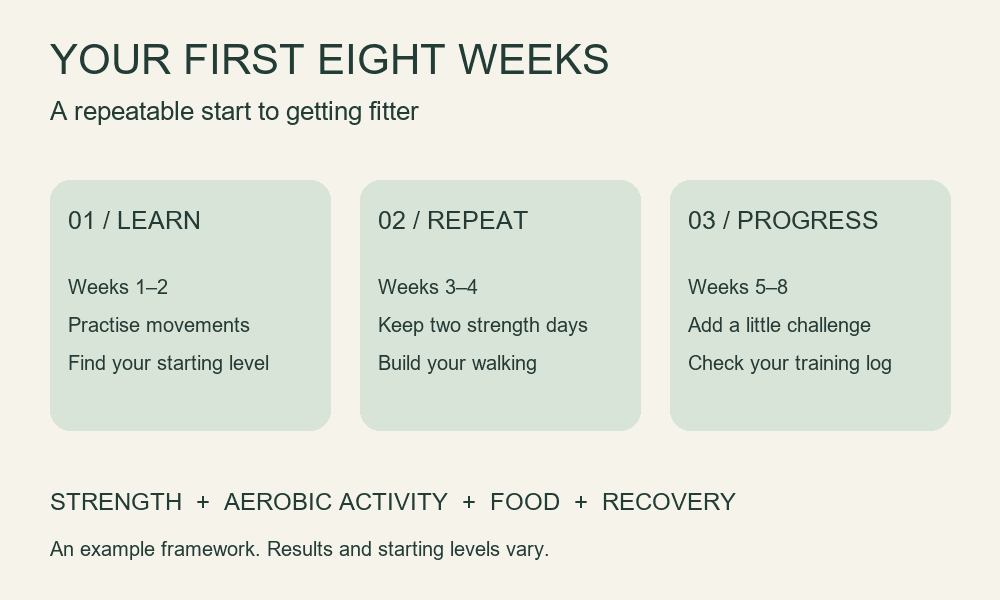
Start with a combination you can sustain: two strength sessions a week, regular walking or other cardio, adequate food and consistent recovery. Repeat that foundation long enough to measure progress, then gradually make it more challenging. You do not need a different workout every day or a diet that leaves you too tired to train.
First, define what “in shape” means to you. Is it carrying shopping upstairs comfortably, feeling stronger, returning to hiking, or reducing excess body fat? A smaller waist and a stronger squat are different outcomes. The best plan gives you a way to measure the outcome you actually want.
This article is for generally healthy adult beginners and women returning after a break. It is an example framework, not an individually prescribed programme or a plan validated as a complete package in a trial. The fundamentals of training are shared across genders; exercise history, symptoms and available time determine the starting point.
How quickly will you notice results?
There is no reliable universal date for a visible transformation. Early progress may show up as better coordination, a more comfortable walk or extra repetitions before it appears in a photograph. Eight weeks gives you a useful review point, not a guarantee that your body will look a particular way.
| Stage | Your practical target | Useful evidence of progress |
|---|---|---|
| Weeks 1–2 | Learn the movements and establish a manageable routine. | You complete sessions and recover before the next one. |
| Weeks 3–4 | Repeat the routine and increase one small element. | More controlled repetitions or an easier walk on the same route. |
| Weeks 5–8 | Progress the resistance or duration when ready. | Your training log shows a clear improvement from your starting point. |
If fat loss is appropriate, avoid turning a general weight-loss target into a weekly pass-or-fail test. NIDDK discusses gradual loss of around 1–2 lb a week in its diabetes-prevention guidance, but this is not a minimum everyone should pursue. Smaller or already-lean people may need a slower approach, or no weight loss at all. Read the NIDDK guidance.
Body weight also reflects water and digestive contents. A single weigh-in cannot tell you how much fat you lost or muscle you gained. If weighing causes anxiety or restrictive behaviour, use performance, energy and the consistency of your routine instead.
Choose the right goal: fat loss, strength or everyday fitness
If you want to lose excess fat
Work toward a modest, sustainable energy deficit while maintaining resistance training and regular meals. Identify one repeatable change: a smaller portion of calorie-dense extras, fewer routine sugary drinks, or a more satisfying planned lunch that reduces grazing later. Avoid simultaneously slashing food and doubling your workouts.
Exercises for the stomach, thighs or arms strengthen those muscles; they do not let you choose where fat is lost. Your programme should train the whole body. The CDC explains how activity and food intake contribute to an energy deficit while also emphasising exercise benefits beyond weight. Read the CDC overview.
If you want to look more defined or “toned”
Translate that word into a training goal: develop strength and muscle, and consider fat loss only if appropriate. Do not choose weights solely because they are marketed to women. Choose a resistance you can control that becomes challenging near the end of the set. Gradually increase it as the exercise becomes easier.
If you want energy and stamina
Focus on what you can do: walk farther, recover your breathing sooner, get up from a chair with confidence or carry a heavier bag. These are worthwhile changes even if your clothing size stays the same. Choose at least one performance measure alongside any appearance-related goal.
Your beginner weekly workout schedule
CDC recommends adults work toward at least 150 minutes of moderate aerobic activity weekly and muscle strengthening on two or more days. You can build toward that level; an inactive beginner does not need to complete it immediately. At moderate intensity you can generally talk, but not sing. See the adult activity guidelines.
| Day | Plan | How to start |
|---|---|---|
| Monday | Full-body strength | Practise the five exercises below. |
| Tuesday | Walk, cycle or swim | Try 10–20 comfortable minutes, or less if needed. |
| Wednesday | Easy movement | Break up sitting with short walks. |
| Thursday | Full-body strength | Repeat Monday; record what you manage. |
| Friday | Comfortable cardio | Repeat a manageable activity and duration. |
| Saturday | An enjoyable active outing | A longer walk or another activity that fits your recovery. |
| Sunday | Recovery and preparation | Arrange the next week's sessions and meals. |
This starting schedule may provide less than 150 aerobic minutes. Add manageable walking breaks or extend sessions gradually as they become comfortable. A short walk after a meal or during a lunch break can make the routine easier to fit around work and family commitments.
Before a strength session, warm up with about five minutes of easy movement and a few easier practice repetitions. Start with one set of each exercise if you are very deconditioned, or two if that feels manageable. Rest around one to two minutes between sets, taking longer when you need it. End a set while you could still perform another two or three controlled repetitions.
Five strength exercises to start with
You need a stable chair, a clear floor, a solid wall and a light dumbbell with stable support for rows. Use a range of motion that feels comfortable. Sharp or worsening pain is a reason to stop, not a target to push through. If technique is unfamiliar, ask a qualified trainer to check your setup.
1. Chair squat: 6–10 repetitions
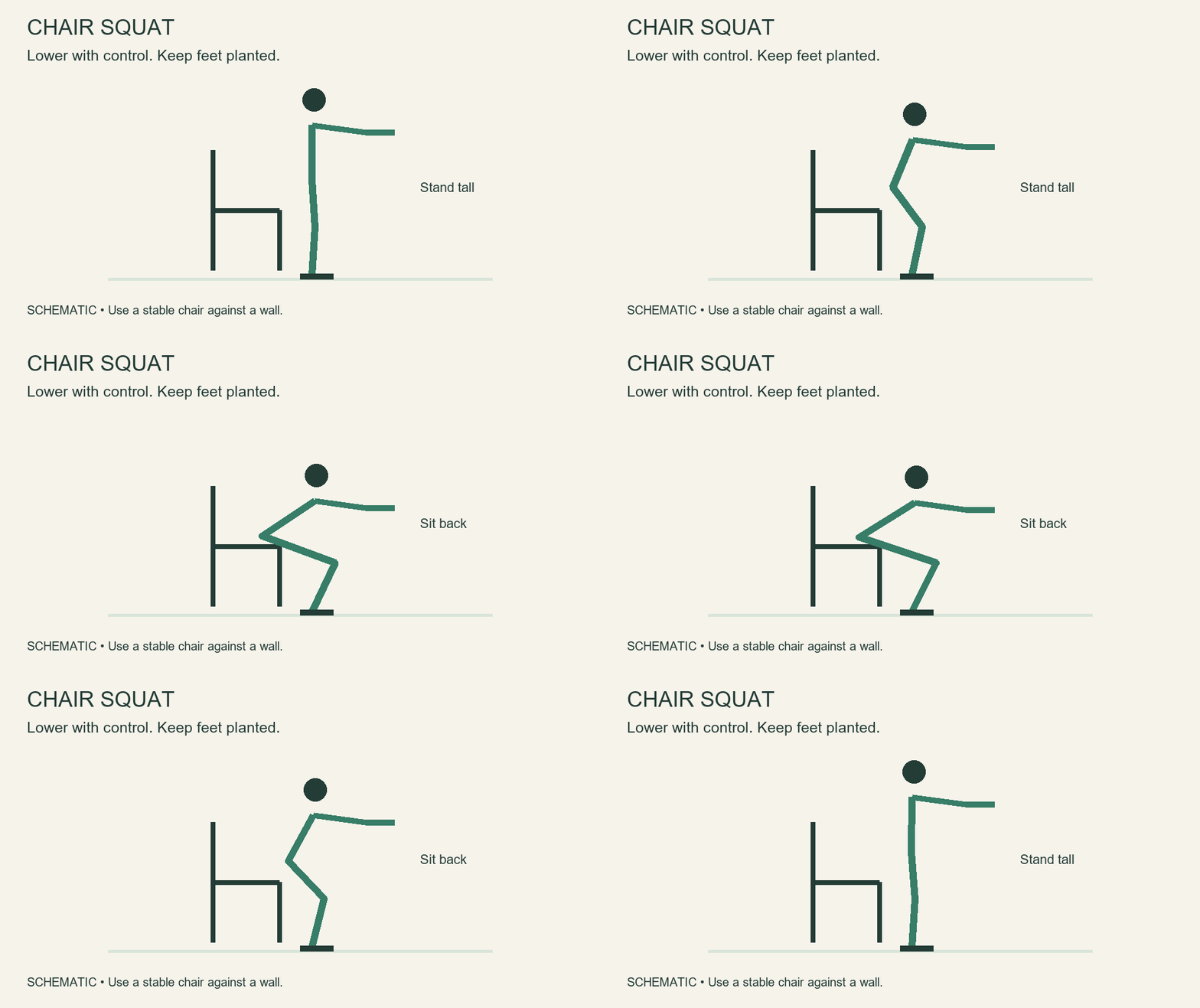
Place a non-wheeled chair against a wall. Stand in front of it with your feet comfortably apart. Bend through your hips and knees, lower slowly to the seat, then stand again. Keep your feet planted and let your knees follow your toes. Try a higher seat or light hand support if needed. Touch down gently rather than dropping onto the chair.
Watch the chair-squat demonstration
2. Wall push-up: 6–12 repetitions
Place your palms against a solid wall at approximately chest height and step back. Keep your body aligned as you bend your elbows and move your chest toward the wall, then push away. Keep your elbows angled slightly back rather than straight out to the sides. Stand closer to make the exercise easier. Progress to a lower, fixed support only when the wall version feels controlled.
3. Supported dumbbell row: 8–12 repetitions per side
Place one hand on a stable bench, take a staggered stance and hinge forward. Keep your back in a comfortable, steady position. Draw a light dumbbell toward your hip with the other hand, then lower it slowly. Avoid twisting your body or shrugging to finish a repetition. Choose a lighter weight if you cannot keep the movement steady.
4. Glute bridge: 8–12 repetitions
Lie on your back with knees bent and feet flat. Gently brace your trunk and lift your hips by pressing through your feet. Stop before the movement becomes an exaggerated lower-back arch, then lower under control. Use a smaller movement if that feels better. This exercise is not a substitute for individual postpartum or pelvic-floor rehabilitation.
5. Bird dog: 5–8 repetitions per side
Start on hands and knees. Reach one arm forward and the opposite leg back while keeping your trunk steady. Pause briefly, return and change sides. Begin by lifting only one limb at a time if balance is difficult. Keeping your pelvis level matters more than reaching as high or as far as possible.
How to make the routine harder without doing too much
Weeks 1–2: find a starting level you can recover from. Record exercises, repetitions and how hard the session felt. If soreness prevents normal movement or interferes with the next workout, reduce the starting volume.
Weeks 3–4: keep the exercise selection steady. Add a second set if you started with one, or add a repetition within the suggested range. Increase a walk by a few minutes when that fits your recovery. Change one thing at a time.
Weeks 5–8: when the top of a repetition range feels controlled with repetitions still available, try a slightly heavier dumbbell or a harder variation. Return toward the lower end of the range. You do not need to make every session harder than the last; some weeks are about maintaining the habit.
ACSM's 2026 resistance-training update emphasises consistency and training major muscle groups at least twice a week. Complicated programming and regularly training to failure are not necessary for the average healthy adult. This is why the starting routine is deliberately simple. Read the ACSM update.
Eat enough to support the work
Build meals around a protein source, vegetables or fruit, and carbohydrate that suits your appetite and activity. Include fats in sensible portions rather than treating all fat as something to avoid. A meal might be tofu with rice and vegetables, lentil soup with bread and yogurt, or fish with potatoes and greens. Convenient food can fit; perfection is not the entry requirement.
Include protein across regular meals. Eggs, dairy, beans, lentils, tofu, fish and meat are options depending on your preferences. A meta-analysis of resistance-training research found no further average improvement in fat-free mass above approximately 1.6 g/kg/day total protein. That is a useful reference for healthy adults training for muscle, not a mandatory target for every woman or a personalised prescription. Read the protein meta-analysis.
At 65 kg, 1.6 g/kg is about 104 g a day, counting food and supplements together. Individual needs differ, particularly with pregnancy, medical conditions or substantial excess weight. Get tailored advice if you need a target. Protein powder is optional; our whey protein guide explains its role.
If fat loss is appropriate, keep the reduction in food manageable. If you are already lean or your main goal is strength, do not automatically start dieting. Persistent hunger, deteriorating recovery and a falling training performance should prompt a review of the overall plan rather than another cut in portions.
Periods, iron and changing energy levels
Keep a simple note of symptoms alongside your training log. If cramps, headaches or fatigue make a session uncomfortable, reduce the load or duration, choose an easier activity, or rest. You do not need to follow a rigid calendar that tells every woman how she must feel on a particular cycle day.
Persistent fatigue deserves attention. NIH notes that iron-deficiency anaemia can cause tiredness and reduced exercise capacity; people with heavy menstrual bleeding may be at greater risk of deficiency. Food sources include meat, beans, lentils and fortified cereals. Vitamin C helps absorption of plant-source iron. Do not start high-dose iron simply because you feel tired: ask a clinician about possible causes and whether testing is appropriate. Read the NIH iron fact sheet.
If your periods stop unexpectedly, bleeding becomes unusually heavy or symptoms interfere with everyday life, seek medical advice rather than assuming exercise explains it. Fitness progress should not depend on ignoring a new health concern.
Pregnancy, postpartum recovery and training after 40
Pregnancy and postpartum: this eight-week routine is not a pregnancy or postnatal rehabilitation plan. CDC recommends moderate activity for healthy pregnant and postpartum women, with a general target of 150 minutes weekly, but exercise selection and return after birth depend on individual circumstances. Discuss appropriate changes with your maternity clinician. Do not use this article as a pregnancy weight-loss programme. See CDC pregnancy and postpartum guidance.
If exercise brings on pelvic heaviness, leaking, pain or other persistent symptoms, seek assessment from an appropriately qualified clinician or pelvic-health physiotherapist. Simply adding more repetitions or working through symptoms is not an individual rehabilitation plan.
After 40 or during menopause: age alone does not mean you need a completely different set of exercises. Start from your current ability and account for sleep disruption, joint symptoms and recovery. Keep strength and aerobic work in the conversation rather than assuming increasingly severe dieting is the answer. If you have osteoporosis, a previous fragility fracture or a significant medical condition, get guidance on suitable loading and movements.
Recover well and measure something useful
Give yourself a regular sleep opportunity. CDC recommends at least seven hours for adults aged 18–60 and provides age-specific ranges for older adults. A short night may call for an easier session; it does not erase your progress. Read the sleep recommendations.
Every two weeks, review three things: how many planned sessions you completed, whether you improved at an exercise or walking route, and whether recovery feels manageable. If body composition is a goal, measure your waist under similar conditions and consider longer-term trends rather than reacting to daily fluctuations.
If progress stalls, check the routine before changing everything. Were workouts consistent? Were the last repetitions meaningfully challenging? Was food intake appropriate to your goal? Is recovery adequate? Make one adjustment and give it time to be assessed. A plan you rewrite every three days provides very little useful feedback.
Your first week: a simple checklist
- Choose a main goal and one practical way to measure it.
- Book two non-consecutive strength sessions.
- Find a comfortable walking route you can repeat.
- Plan a reliable meal for the busiest part of your day.
- Review how you feel before increasing the workload.
You do not need to earn the right to start by being lighter, stronger or more confident. Start at a level that fits today, record the work and progress when it becomes manageable. For the companion guide, see our eight-week fitness plan for men; the core training principles are shared.
Your questions
Can women get in shape in one month?
A month can establish a routine and show improvements in movement control or stamina. It cannot guarantee a particular appearance or amount of fat loss. Use the first month to build a foundation and measure progress.
Is walking enough to get in shape?
Walking is a useful aerobic foundation. Adding strength training helps you work toward a broader fitness goal; adult guidelines recommend both aerobic activity and muscle strengthening.
Can I do this workout at home?
Yes. This routine uses a stable chair, wall, floor space and a light dumbbell with stable support for rows. Use safe equipment and get technique guidance if an exercise is unfamiliar.
Do women need different weights from men?
Choose resistance according to your strength, technique and the exercise. A weight should be challenging while allowing controlled repetitions. Gender labels on equipment do not determine the right load.
Should I work out during my period?
Adjust according to how you feel rather than following a compulsory schedule. Easier movement, reduced training or rest can all be reasonable when symptoms interfere. Persistent or severe symptoms warrant medical advice.
Is this a postpartum workout plan?
No. Return to activity after birth requires consideration of recovery, symptoms and individual medical advice. Use a programme suited to your circumstances rather than treating a general beginner routine as rehabilitation.
References
- CDC. Adult Activity: An Overview. cdc.gov
- ACSM. Updated resistance-training guidelines, 2026. acsm.org
- NIDDK. Your Game Plan to Prevent Type 2 Diabetes. niddk.nih.gov
- CDC. Physical Activity and Your Weight and Health. cdc.gov
- Morton RW et al. Protein supplementation and resistance-training adaptations: systematic review and meta-analysis. BJSM, 2018. pubmed.ncbi.nlm.nih.gov
- NIH Office of Dietary Supplements. Iron: Consumer Fact Sheet. ods.od.nih.gov
- CDC. Pregnant & Postpartum Activity: An Overview. cdc.gov
- CDC. About Sleep. cdc.gov