Does eating half a grapefruit before meals help you lose weight?
A little, but not because grapefruit is special. In one trial, half a grapefruit before each meal led to 1.6 kg of weight loss over 12 weeks against 0.3 kg on placebo — but a later trial found a glass of water before meals worked just as well. Grapefruit is a filling, low-calorie starter rich in vitamin C. The part that matters more is safety: it interacts with more than 85 medicines, including some statins.
The short answer
A little — but not because grapefruit is special. The “grapefruit diet” has been around since the 1930s, and one modern trial seemed to back it: people who ate half a grapefruit before each meal lost 1.6 kg over 12 weeks, against 0.3 kg on placebo. But a larger trial then compared grapefruit with a glass of water before meals, and everyone lost the same amount. The likely explanation is simple: starting a meal with something filling and low in calories means you eat a little less of the rest.
So half a grapefruit is a good starter — about 52 kcal, mostly water, with half a day’s vitamin C — but a salad, a bowl of broth or a glass of water can do the same job. And before you start, there is one thing that matters more than any weight effect: grapefruit interacts with a long list of common medicines, including some statins and blood-pressure drugs.
What half a grapefruit gives you
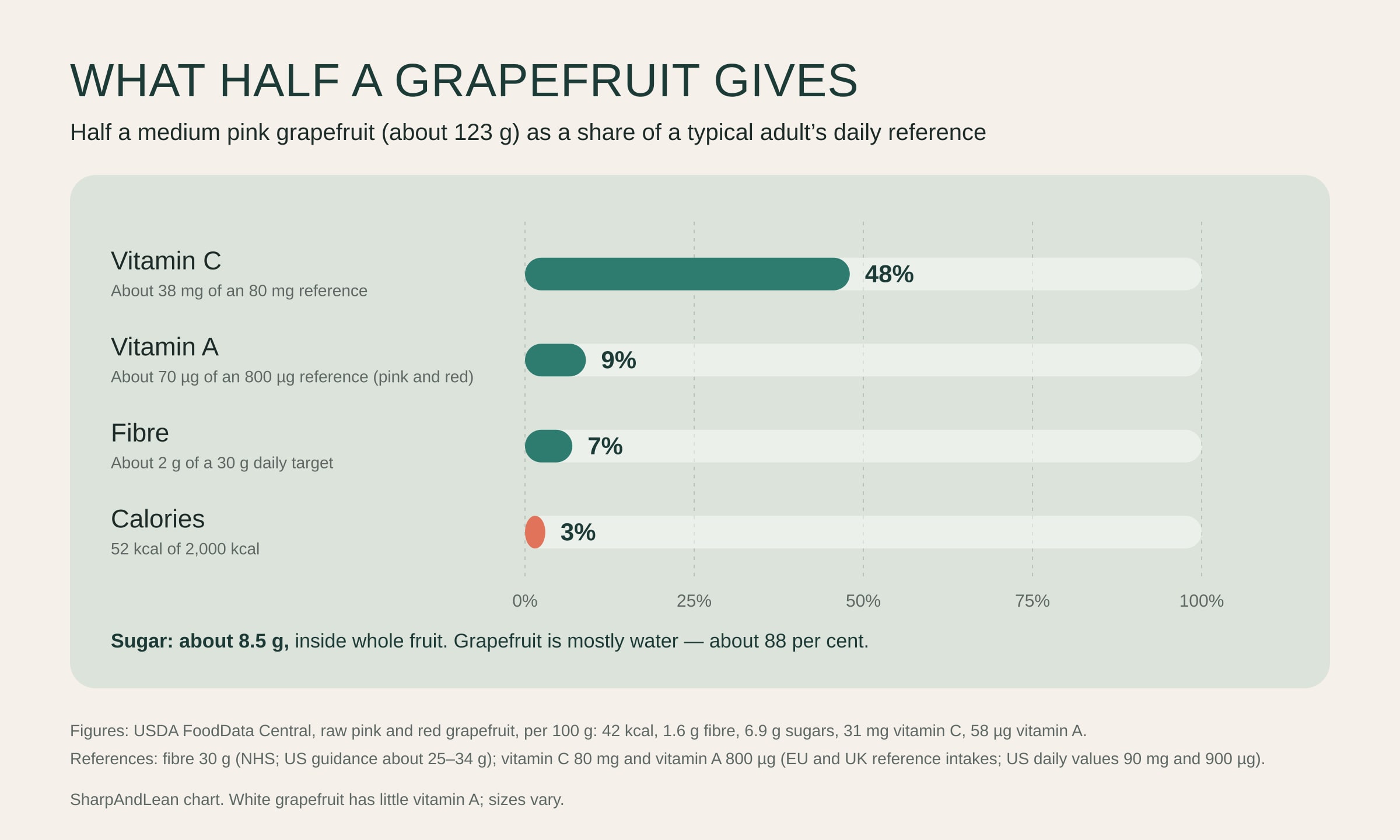
Half a medium grapefruit weighs about 123 g and has about 52 kcal, 2 g of fibre, 8.5 g of natural sugar and 38 mg of vitamin C — close to half the EU and UK daily reference — according to USDA FoodData Central. Pink and red grapefruit also carry some vitamin A as beta-carotene; white grapefruit has very little. It is about 88 per cent water, which is much of why it is filling for so few calories.
For blood sugar, grapefruit is one of the gentlest fruits there is: a glycaemic index of about 25 and a glycaemic load of about 3 per 120 g, the lowest in our fruit and diabetes guide.
What the trials found
The trial that revived the grapefruit diet
In a 2006 study at the Scripps Clinic, 91 adults with obesity took one of four things three times a day before meals for 12 weeks: half a fresh grapefruit, a glass of grapefruit juice, grapefruit capsules, or a placebo capsule with apple juice. The fresh grapefruit group lost 1.6 kg, the juice group 1.5 kg, the capsule group 1.1 kg and the placebo group 0.3 kg. People eating fresh grapefruit also had lower insulin levels two hours after a sugar drink, a sign of better insulin sensitivity.
That sounds impressive, but the differences are small — about 1.3 kg over three months compared with placebo — the trial was modest in size, and the comparison drink contained sugar.
The trial that tested it against water
A 2011 trial at Vanderbilt University asked a sharper question. After two weeks of cutting calories, 85 adults with obesity took a preload of 127 g of grapefruit, grapefruit juice or water before three meals a day for 12 weeks, alongside a lower-calorie diet. All three groups lost about 7 per cent of their body weight, with falls in body fat and waist size — and there was no significant difference between them.
Put together, the trials suggest that a low-calorie “preload” before meals helps people eat less, and grapefruit is one pleasant way to do it. There is no good evidence that grapefruit burns fat or has a special effect on weight beyond that. The idea that it contains fat-burning enzymes is a myth.
A week of half a grapefruit before meals: what to expect
| When | What is likely |
|---|---|
| From the first meal | You may feel fuller sooner and eat a little less of the main course. It is 52 kcal instead of whatever else you might have started with. |
| Through the week | A big lift in vitamin C: half a grapefruit before two meals gives more than a day’s reference amount. Little change in digestion — grapefruit is low in fibre compared with pears or prunes. |
| On the scales | Probably nothing you can separate from normal daily swings. In the trials, the losses built up over 12 weeks, and only alongside eating less overall. |
Some people find grapefruit acidic on the stomach, or that it triggers heartburn; if so, eat it with or after food rather than on an empty stomach.
Grapefruit and medicines: read this first
Grapefruit contains natural compounds called furanocoumarins that block an enzyme in the gut wall, CYP3A4, which normally breaks down many medicines before they reach the bloodstream. With that enzyme blocked, more of the drug gets through, and blood levels can rise to the point of harm. A 2013 review in the Canadian Medical Association Journal counted more than 85 medicines that interact with grapefruit, many of them with serious possible effects.
The effect can last a day or more after a single grapefruit or glass of juice, so taking your tablets at a different time of day does not reliably avoid it. Medicines affected include:
- Some statins, such as simvastatin and atorvastatin, where higher levels raise the risk of muscle damage.
- Some blood-pressure medicines, such as felodipine and nifedipine.
- Some heart-rhythm medicines, such as amiodarone.
- Some medicines that suppress the immune system, such as ciclosporin and tacrolimus.
- Some anti-anxiety, anti-sickness, cancer and HIV medicines.
Not every medicine in these groups is affected, and the list changes as new drugs appear. The US Food and Drug Administration and the patient leaflet in your medicine’s box are good places to check; a pharmacist can tell you in a minute. Seville oranges (used in marmalade), pomelos and some grapefruit hybrids contain the same compounds.
How to do it well
- Check your medicines first. If any of them interact, choose an orange or another low-calorie starter instead.
- Eat the fruit, not the juice. The fruit is more filling and its sugars are not free sugars. Juice worked in one trial, but it is easy to drink more calories than you meant to.
- Skip the sugar. A spoonful of sugar or honey on top undoes much of the point.
- Treat it as one tool. Any filling, low-calorie starter — salad, vegetable soup, a large glass of water — works in the same way. Choose the one you will keep doing.
- Look after your teeth. Grapefruit is acidic; rinse with water afterwards and wait a while before brushing.
The bottom line
Half a grapefruit before meals is a reasonable, low-calorie way to take the edge off your appetite and lift your vitamin C — and in trials, people who used it lost a little weight over three months. So did people who drank water instead. It is not a fat burner, and a week will not show on the scales. If you take any regular medicine, check with a pharmacist before making grapefruit a habit.
Your questions
Does grapefruit burn fat?
No. There is no good evidence that grapefruit burns fat or contains fat-burning enzymes. In trials, grapefruit before meals helped people eat a little less, but water before meals worked just as well in a 12-week comparison.
How much weight can you lose eating grapefruit before meals?
In a 2006 trial, half a grapefruit before each meal led to 1.6 kg of weight loss over 12 weeks, against 0.3 kg on placebo. In a 2011 trial alongside a lower-calorie diet, grapefruit, grapefruit juice and water preloads all led to about 7 per cent weight loss, with no difference between them.
Which medicines should not be taken with grapefruit?
More than 85 medicines interact with grapefruit, including some statins (such as simvastatin and atorvastatin), some blood-pressure drugs (such as felodipine and nifedipine), amiodarone, ciclosporin and some cancer, HIV and anti-anxiety medicines. Check your medicine’s leaflet or ask a pharmacist.
Can I avoid the interaction by taking my tablets at a different time?
Not reliably. The effect of grapefruit on the gut enzyme that breaks down these medicines can last a day or more, so spacing them out does not make it safe. If a medicine interacts, avoid grapefruit and grapefruit juice altogether.
Is grapefruit good for diabetes?
It is one of the gentlest fruits for blood sugar, with a glycaemic index of about 25 and a very low glycaemic load. But many heart medicines that people with diabetes often take, including some statins and blood-pressure drugs, interact with grapefruit, so check your medicines first.
Is pink grapefruit healthier than white?
Pink and red grapefruit contain beta-carotene, which the body turns into vitamin A, and lycopene; white grapefruit has very little of either. Both have similar vitamin C, fibre and calories.
References
- USDA FoodData Central. Grapefruit, raw, pink and red — per 100 g: 42 kcal, 10.7 g carbohydrate, 6.9 g sugars, 1.6 g fibre, 31.2 mg vitamin C, 58 µg vitamin A. Half a medium grapefruit is about 123 g. fdc.nal.usda.gov
- Fujioka K, Greenway F, Sheard J, Ying Y (2006). The effects of grapefruit on weight and insulin resistance: relationship to the metabolic syndrome. Journal of Medicinal Food 9(1):49-54. pubmed.ncbi.nlm.nih.gov
- Silver HJ, Dietrich MS, Niswender KD (2011). Effects of grapefruit, grapefruit juice and water preloads on energy balance, weight loss, body composition, and cardiometabolic risk in free-living obese adults. Nutrition & Metabolism 8. pubmed.ncbi.nlm.nih.gov
- Bailey DG, Dresser G, Arnold JMO (2013). Grapefruit–medication interactions: forbidden fruit or avoidable consequences? Canadian Medical Association Journal 185(4):309-316. pubmed.ncbi.nlm.nih.gov
- US Food and Drug Administration. Grapefruit juice and some drugs don’t mix — consumer update. fda.gov
Page history
- First published, with an illustration and a chart of what half a grapefruit gives. Nutrition figures from USDA FoodData Central; evidence from the trials listed. Not yet reviewed by a clinician.