How to Get in Shape Fast for Men: Your First 8 Weeks
You do not need a punishing six-day split to start looking and feeling fitter. Here is a practical eight-week framework for men: two strength sessions, manageable cardio, meals that support your goal, and a way to tell whether it is working.

What is the fastest realistic way for a man to get in shape?
The most useful starting combination is regular strength training, aerobic activity you can recover from, food that matches your goal, and enough sleep. Make the routine small enough to repeat during an ordinary working week. Then increase the challenge as your fitness improves.
“In shape” can mean several things: a smaller waist, more muscle, climbing stairs without stopping, or returning to sport. Write down which one matters most. Otherwise, it is easy to chase a lower scale weight while also expecting maximum muscle growth, then decide the plan has failed because those goals pull your eating in different directions.
This guide is for generally healthy adult beginners and men returning after a break. The training principles are not exclusive to men. Your starting fitness, injuries, schedule and recovery matter more than the word “male” on a workout plan.
If you have chest pain, fainting, unexplained breathlessness, a recent operation or a condition that affects exercise, get individual advice before increasing intensity. Stop exercising and seek urgent help for chest pain or fainting during a session. Normal effort is expected; sharp or worsening pain is a reason to stop and reassess.
How long does it take to get in shape?
There is no honest universal deadline. Learning a movement, improving endurance, gaining muscle and losing fat happen on different timelines. Treat the next eight weeks as a training block with measurable actions, rather than a before-and-after promise.
| Checkpoint | What to assess | What not to assume |
|---|---|---|
| Weeks 1–2 | Can you complete the sessions and recover before the next one? | Soreness does not measure workout quality. |
| Weeks 3–4 | Can you do more controlled repetitions or walk the same route more comfortably? | A quick scale drop is not all body fat. |
| Weeks 5–8 | Compare your waist, training log and walking performance with your baseline. | A dramatic visual change is not guaranteed. |
If losing excess weight is appropriate, gradual loss is a better starting expectation than a crash diet. NIDDK describes roughly 1–2 lb (0.45–0.9 kg) a week as a reasonable short-term goal in its diabetes-prevention guidance. This is context, not a minimum everyone should achieve. Smaller or already-lean men may need a slower approach. Read the NIDDK guidance.
Choose your goal before changing your diet
If your priority is losing belly fat
Use a manageable reduction in overall food energy while keeping strength training in the week. Start with an identifiable change: replace a routine sugary drink, reduce a large snack portion, or serve a smaller amount of calorie-dense extras. Keep regular meals rather than trying to compensate for overeating with an exhausting workout.
Abdominal exercises strengthen your trunk, but they do not let you choose where fat disappears. Track your waist and overall trend instead of judging the plan by a daily mirror check. The CDC explains that weight loss involves an energy deficit and that physical activity also has benefits beyond weight. Read the CDC explanation.
If you are already lean and want more muscle
Do not automatically copy a fat-loss diet. Begin with regular, adequate meals and progressive strength training. If you are consistently hungry, losing weight unintentionally or struggling to recover, reassess whether you are eating enough. A registered dietitian can help set an intake that fits your size and goal.
If you mainly want to feel fitter
Choose performance measures: a comfortable thirty-minute walk, getting up from a chair more easily, or completing the same workout with better control. Body weight can stay similar while these things improve. You do not need to pursue weight loss to benefit from exercise.
A beginner workout plan you can repeat each week
The following is an example routine, not a programme tested as a complete package in a clinical trial. It turns broad activity guidance into a workable starting week. CDC recommends at least 150 minutes of moderate aerobic activity, or 75 minutes of vigorous activity, plus muscle strengthening on at least two days weekly. If you are inactive, build toward that amount gradually. See the adult activity guidelines.
| Day | Activity | Starting approach |
|---|---|---|
| Monday | Full-body strength | The five movements below, at a controlled pace. |
| Tuesday | Walk or cycle | 10–20 comfortable minutes, adjusted to your starting fitness. |
| Wednesday | Easy movement | A short walk and breaks from prolonged sitting. |
| Thursday | Full-body strength | Repeat Monday and record repetitions. |
| Friday | Walk or cycle | A repeatable route or duration. |
| Saturday | Longer easy activity | A walk, swim or bike ride you enjoy. |
| Sunday | Recovery and planning | Prepare meals and schedule the next two strength sessions. |
This starting week may fall below 150 aerobic minutes. As it becomes comfortable, add short walks or extend existing sessions toward that target. At moderate intensity you should generally be able to talk, but not sing. You do not have to introduce sprint intervals to make the plan count.
Before strength training, spend about five minutes moving gently and rehearsing easier versions of the movements. Begin with one set of each exercise if you are very deconditioned; otherwise try two. Rest around one to two minutes between sets, or longer until breathing and control have recovered. Finish each set with the sense that you could perform another two or three good repetitions.
Five exercises for your full-body sessions
These are simple starting options. Use stable equipment, a clear floor and a pain-free range. The realistic images are AI-generated illustrations; they cannot assess your individual technique. Ask a qualified trainer to check your setup if you are unsure.
1. Chair squat: 6–10 repetitions
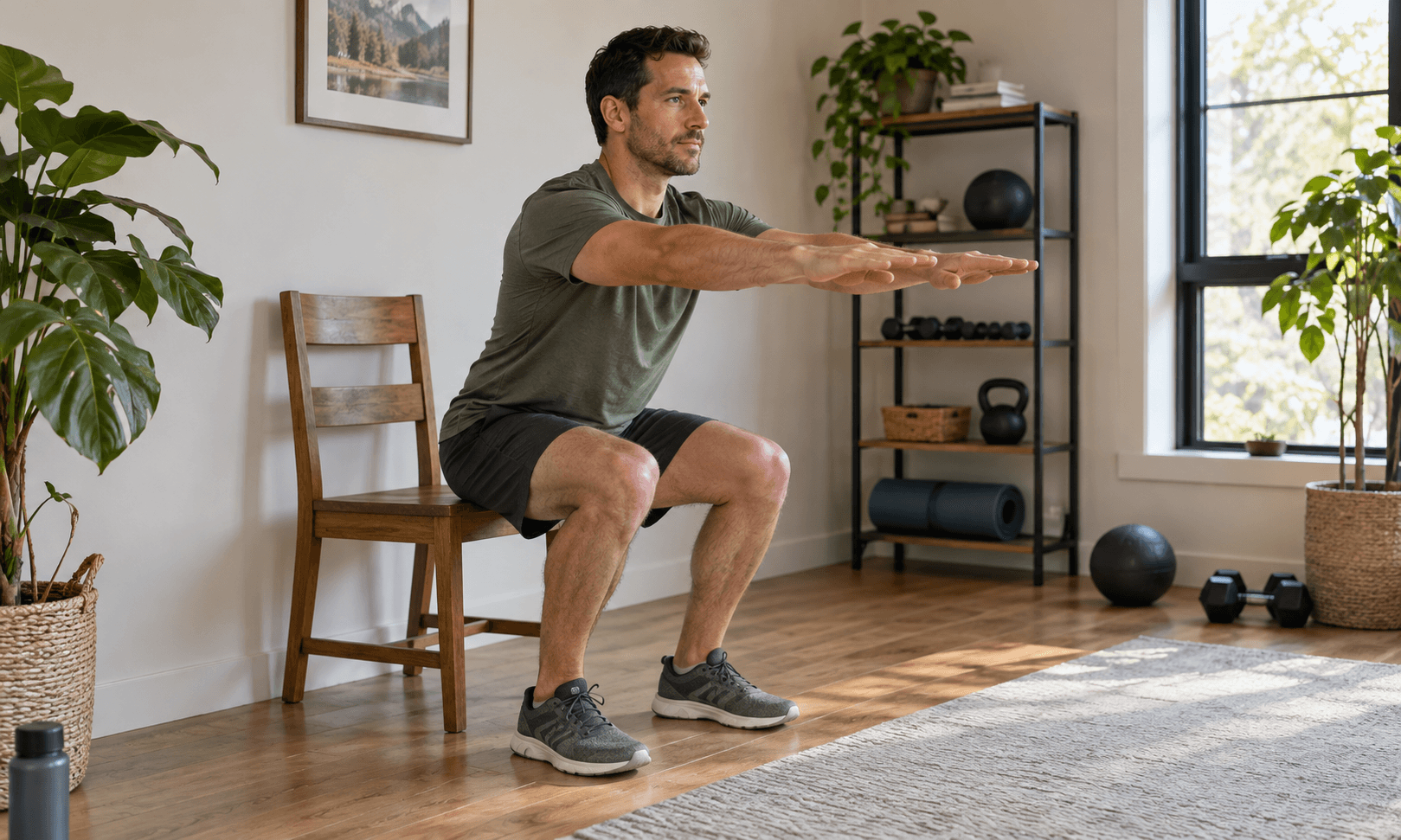
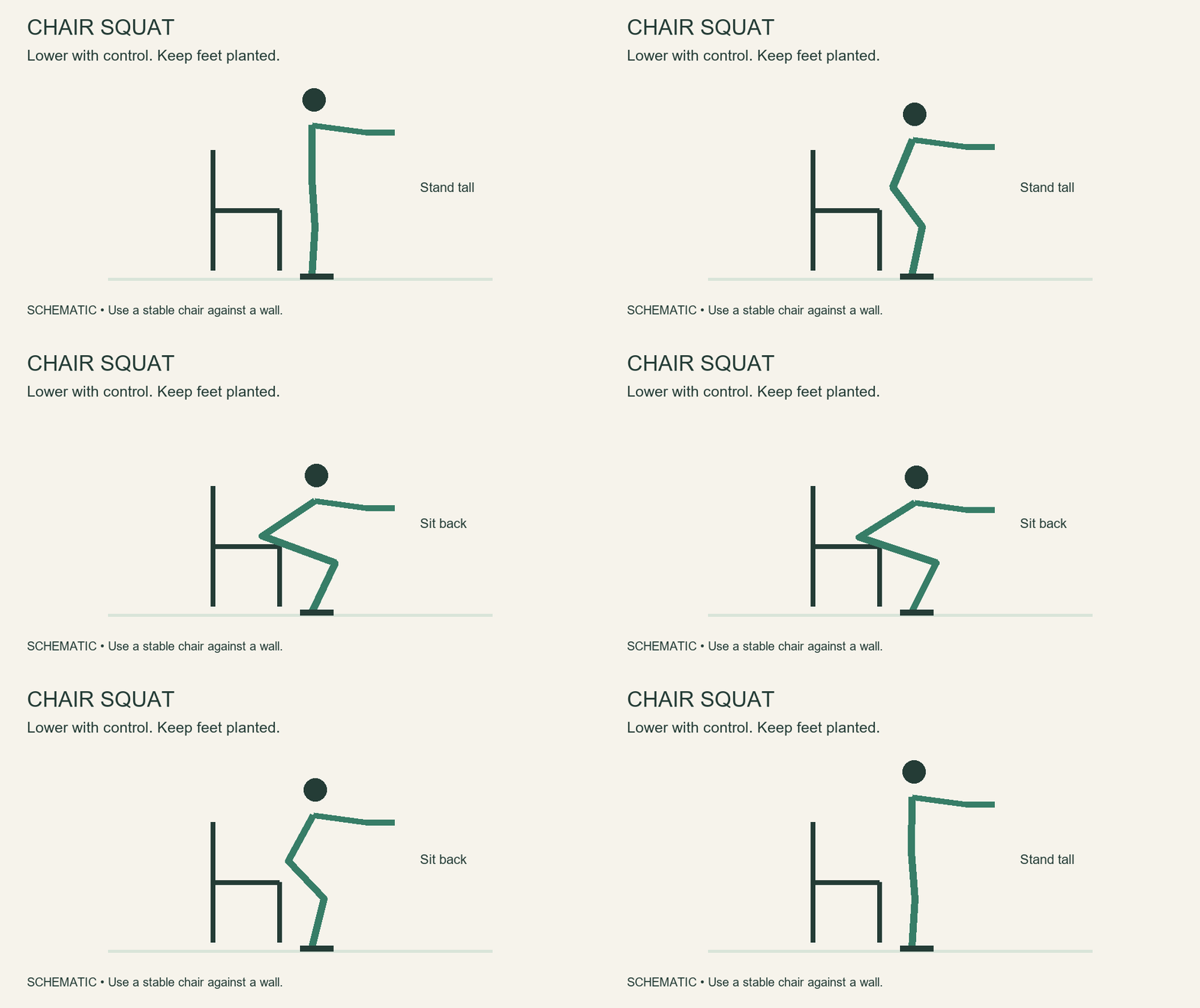
Place a sturdy, non-wheeled chair against a wall. Stand in front of it with feet about hip-to-shoulder width apart. Bend your hips and knees, sit back slowly, touch down gently and stand again. Let your knees follow the direction of your toes. Use a higher seat or light hand support if needed; do not drop into the chair.
Show the chair-squat GIF demonstration
2. Wall push-up: 6–12 repetitions
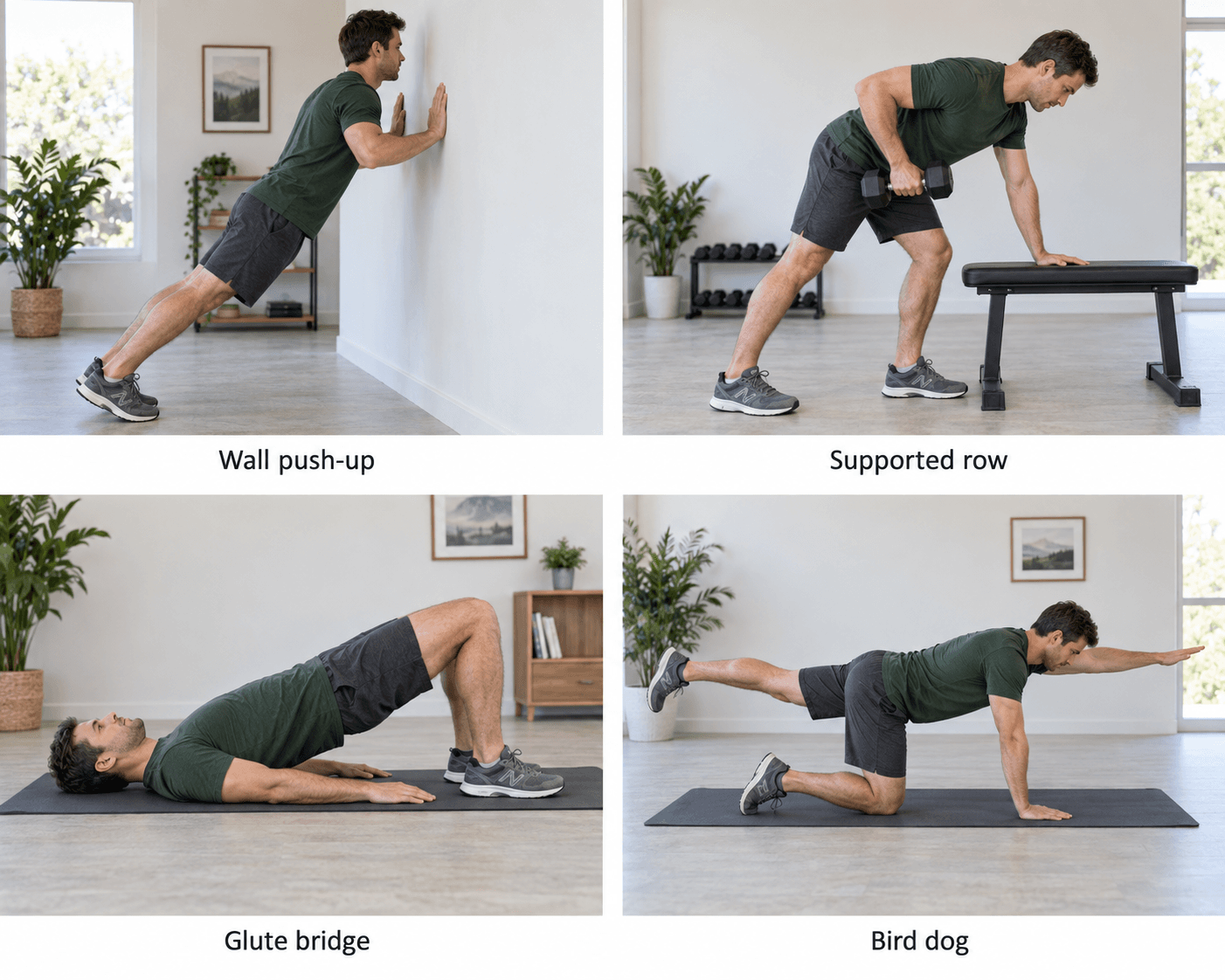
Put your hands on a solid wall around chest height and step back. Keep your body aligned from head to heels, bend your elbows to bring your chest toward the wall, then push away. Avoid flaring your elbows straight out to the sides. Step closer to make it easier. When that becomes comfortable, a fixed, sturdy counter can offer a harder incline.
3. Supported dumbbell row: 8–12 repetitions each side
Support one hand on a stable bench and take a staggered stance. Hinge forward with a comfortable, steady back position. With a light dumbbell in the other hand, draw your elbow toward your hip, then lower slowly. Keep your torso still. Start lighter if you need to twist or jerk the weight upward. A seated row machine is an alternative if a trainer shows you the setup.
4. Glute bridge: 8–12 repetitions
Lie on your back with knees bent and feet flat. Gently brace your trunk and press through your feet to lift your hips. Stop before the movement turns into an exaggerated lower-back arch, then lower slowly. You should control both directions. Reduce the height if your back feels uncomfortable.
5. Bird dog: 5–8 repetitions each side
Begin on hands and knees. Reach one arm forward and the opposite leg back without rotating your trunk or lifting your lower back into an arch. Pause briefly and return. If balancing is difficult, move only an arm or a leg at first. Reaching farther is less useful than keeping the movement steady.
How to progress through the eight weeks
Weeks 1–2: establish a baseline. Learn the exercises, record what you do and find a walking duration you can repeat. If soreness disrupts your next session, reduce the starting workload. The first goal is a routine you can return to.
Weeks 3–4: build consistency. If you began with one set, consider adding a second. Otherwise, add a repetition within the suggested range or a few minutes to a walk. Change one thing at a time so you can judge the response.
Weeks 5–8: add difficulty gradually. When you can complete the top of a repetition range with steady technique and repetitions still in reserve, use a slightly heavier dumbbell or a modestly harder exercise variation. Return toward the lower end of the range. Keep the two strength days separated by recovery time.
ACSM’s 2026 guidance emphasises training major muscle groups at least twice weekly and individualising the programme; training to failure and complicated programming are not necessary for the average healthy adult. That supports keeping a beginner routine straightforward. It does not mean every person should lift the same load. Read the ACSM update.
What to eat to support faster progress
Build repeatable meals around a protein source, vegetables or fruit, and a carbohydrate portion suited to appetite and activity. Add fats in portions you can account for. A practical day might include eggs or yogurt at breakfast, a chicken, tofu or bean lunch, and fish, lentils or another protein source at dinner. Rice, potatoes, oats and bread can all fit; cutting out a staple is not a requirement.
For a healthy adult doing resistance training, around 1.6 g of protein per kilogram of body weight daily is a useful reference point rather than a compulsory threshold. At 80 kg, that is about 128 g across the day, including food. A meta-analysis of resistance-training studies found no further average gain in fat-free mass above approximately that intake. It is not a precise individual ceiling or a weight-loss prescription. Read Morton and colleagues’ analysis.
Do not mechanically multiply a high body weight into an extreme protein target. If you have substantial excess weight, kidney disease or another condition affecting nutrition, get a personalised target. Protein powder is an optional convenience when food leaves a gap, not a prerequisite. Our whey protein guide explains what the evidence can and cannot tell you.
Prepare two or three meals you genuinely like. Keep a convenient protein option and fruit available for busy days. If fat loss is the goal, look at drinks, snacks and weekend portions before making your main meals unnecessarily restrictive. Drink water regularly, with needs adjusted for heat and activity; dehydration is not a fat-loss method.
Recovery: the part that makes the next workout possible
Protect a regular sleep window. CDC recommends at least seven hours for adults aged 18–60, with age-specific ranges for older adults. Treat that as a baseline to work toward, not permission to ignore persistent tiredness. See CDC’s sleep guidance.
If work or family commitments cut your sleep short, adjust that day’s workout instead of treating the original plan as a test of character. Keep the habit with a shorter session or comfortable walk. Persistent exhaustion, disruptive snoring or waking unrefreshed deserves attention rather than another stimulant.
Track the right things and avoid common traps
Keep a short training log: exercise, load, repetitions and how difficult the session felt. Measure your waist under similar conditions every couple of weeks if body composition is a goal. If you weigh yourself, use comparable morning conditions and look at averages rather than one reading. Skip weighing if it encourages distress or compulsive restriction.
At the end of each fortnight, ask whether you followed the routine, recovered, and improved at something. If fat loss is appropriate and neither weight nor waist trends change over several consistent weeks, review portions and activity before making one small adjustment. If strength, energy and recovery are falling, adding more training may worsen the problem.
- Changing workouts every session: makes it harder to see whether you are improving.
- Training hard every day: can make the next planned session harder to complete.
- Chasing sweat: confuses heat and fluid loss with a productive training stimulus.
- Trying to earn food through exercise: turns eating and movement into an unsustainable bargain.
- Buying a shortcut first: spends attention on supplements before the basic routine exists.
Your first seven days
- Write down one main goal and one measure of progress.
- Put two strength sessions into your calendar.
- Choose a comfortable walking route and repeat it.
- Plan a protein-containing meal for your busiest part of the day.
- Set a realistic bedtime and review the week before adding more work.
The fastest useful plan is the one that produces another good week. Start with enough work to improve, learn from the record you keep, and make the next step slightly more demanding when you are ready.
Your questions
Can a man get in shape in 30 days?
Thirty days can establish a routine and reveal improvements in exercise control or endurance. A specific amount of fat loss, muscle gain or visible definition is not guaranteed. Use the first month to build a baseline you can progress from.
Can I get in shape at home?
Yes. Walking and simple strength exercises can form a useful starting programme. This routine uses a stable chair, wall, floor space and a light dumbbell with stable support for rows. Choose equipment and variations you can use safely.
Should men do cardio or weights first?
Put the activity most important to your goal first when combining them. For learning strength exercises, do them while fresh after an easy warm-up, then add comfortable cardio or schedule it on another day.
How do men get rid of belly fat?
When excess fat loss is appropriate, focus on a sustainable overall energy deficit, strength training and regular activity. Abdominal exercises strengthen the trunk but do not select the area from which fat is lost.
Is this plan suitable for men over 40?
Age alone does not determine the programme. Starting fitness, joint symptoms, medical conditions and recovery matter. Begin at a manageable level and get individual guidance when your health or symptoms call for it.
References
- CDC. Adult Activity: An Overview. Aerobic activity and muscle-strengthening recommendations. cdc.gov
- ACSM. Updated resistance training guidelines, 2026. acsm.org
- NIDDK. Your Game Plan to Prevent Type 2 Diabetes. Gradual weight-loss goals. niddk.nih.gov
- CDC. Physical Activity and Your Weight and Health. cdc.gov
- Morton RW et al. Protein supplementation and resistance-training gains: systematic review and meta-analysis. British Journal of Sports Medicine, 2018. pubmed.ncbi.nlm.nih.gov
- CDC. About Sleep. Age-specific sleep recommendations. cdc.gov