What happens if you eat two pears a day for a week?
About 11 g more fibre a day — pears are among the highest-fibre everyday fruits — plus a natural sugar alcohol that makes pears one of the most reliable fruits for keeping you regular. Expect easier digestion, some early wind and meals that fill you up sooner. Blood pressure and weight take longer. Here is what to expect, day by day, and what the research behind each change actually shows.
The short answer
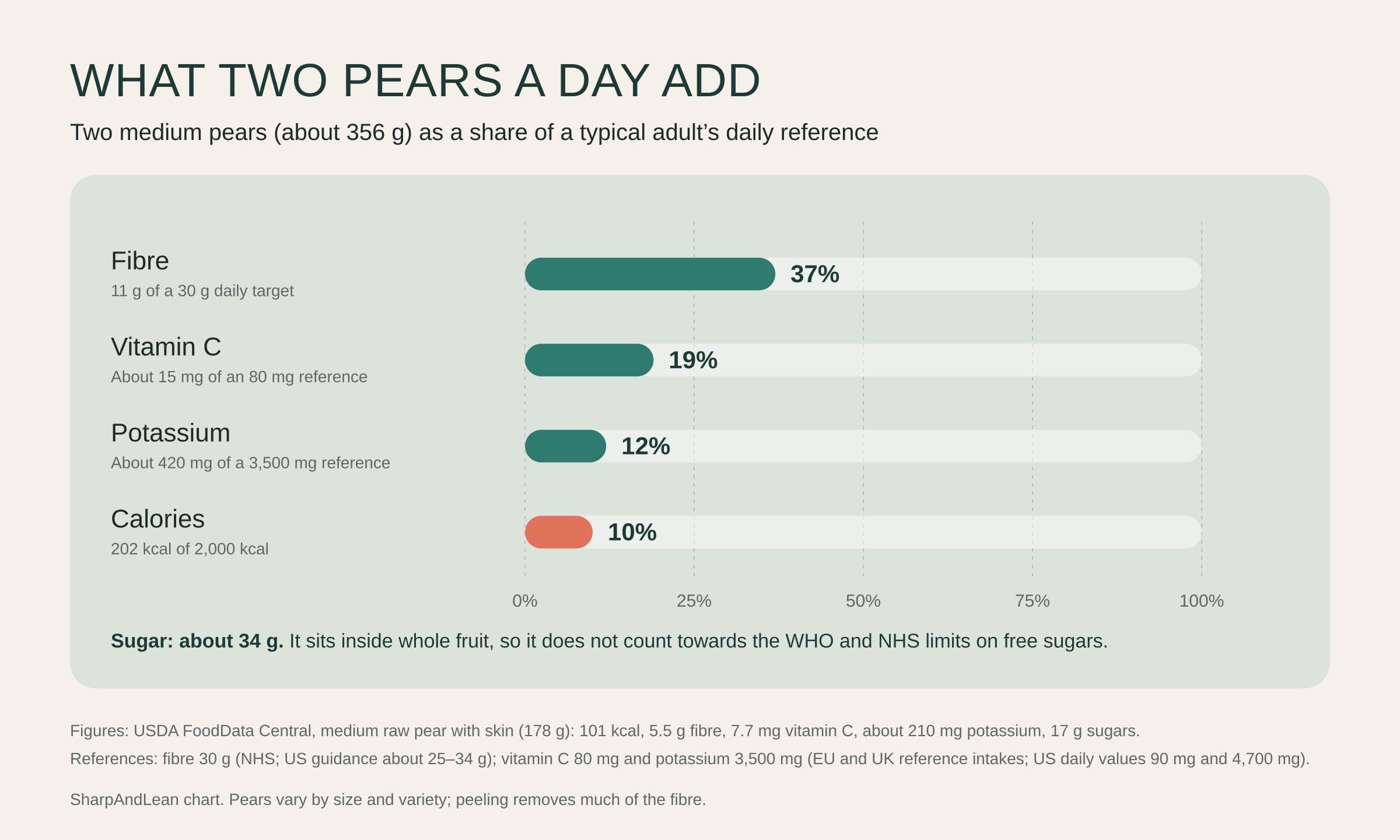
Eat two pears a day for a week and the first change is about 11 g more fibre a day, for around 200 kcal — a little more fibre than two apples. The change you are most likely to notice is in your digestion: pears pair their fibre with sorbitol, a natural sugar alcohol that draws water into the bowel, so they tend to make you more regular within days, often with some wind at first. You may also find meals fill you up sooner.
What a week will not do is lower your blood pressure or cholesterol, or produce real weight loss. The best pear trial measured its effects after 12 weeks. This article goes through what to expect day by day, then each change and the evidence for it — including where the evidence is about fruit in general rather than pears in particular.
We assume two medium pears a day, eaten whole with the skin, on top of or in place of an existing snack. That is the amount used in the main pear trial, and it is easy to keep up.
If you have read our two apples a day for a week article, much will be familiar. The differences are that pears bring more fibre and more sorbitol, and that there are fewer pear-specific studies.
What two pears a day give you
A medium pear (about 178 g, with skin) has 101 kcal, 5.5 g of fibre, 17 g of natural sugar, about 8 mg of vitamin C and about 210 mg of potassium, according to USDA FoodData Central. Double that, and you get the figures in the chart above.
The fibre is the headline. Guidance is similar around the world: the World Health Organization advises at least 25 g a day, the NHS 30 g, and US guidelines about 14 g per 1,000 kcal — roughly 25 to 34 g for most adults. Most people fall well short, so 11 g is a big top-up from two pieces of fruit. Much of it is in or just under the skin, and pears also contain small gritty “stone cells” that add to their insoluble fibre.
The sugar, about 34 g, is not the sugar health guidelines warn about. The World Health Organization’s limits on free sugars exclude sugars inside whole fresh fruit, because there is no evidence they cause harm. Pear juice is different: its sugars count as free sugars.
Day by day: what to expect
| When | What is likely | Why |
|---|---|---|
| Days 1–2 | Meals that fill you up sooner if a pear comes first. Snacks swapped out, if you use pears to replace them. | Fibre and water — pears are about 84 per cent water — take up room and slow digestion. |
| Days 2–4 | Softer, more frequent stools. More wind and, for some people, bloating. | Sorbitol and fructose draw water into the bowel, and gut bacteria ferment the new fibre. |
| Days 5–7 | Digestion usually settles into a more regular pattern. | Your gut adapts to a steady fibre intake. |
| Weeks, not days | Possibly lower blood pressure in people with metabolic syndrome; a little weight lost if pears replace other snacks. | These need weeks of steady intake, and the effects are modest. |
Everyone starts from a different place. If your diet is low in fibre, the digestive changes will be more obvious, and it is worth starting with one pear a day for a few days before moving to two.
The 7 changes, and what the research shows
1. You eat about 11 g more fibre a day
This happens on day one. Two medium pears cover over a third of a 30 g fibre target — more than two apples or two bananas. Fibre from fruit comes with water, vitamin C and potassium that a fibre powder does not provide, though a powder such as psyllium husk is a reasonable option for anyone who cannot get enough from food.
2. You are likely to become more regular
This is where pears stand out. As well as fibre, they contain sorbitol, a sugar alcohol the gut absorbs poorly, and more fructose than glucose. Both draw water into the bowel and soften stools — which is why pear juice has long been suggested for constipation, especially in young children. For most people, two pears a day means softer, more frequent bowel movements within a few days.
A caveat: pears themselves have not been tested in trials for constipation the way prunes, kiwifruit and psyllium have. The effect is well explained by what pears contain, and widely reported, but the trial evidence belongs to those other foods.
3. Early wind and bloating — then it usually settles
The same sorbitol and fructose that help regularity are FODMAPs, and Monash University’s FODMAP testing rates pears as high in both. Gut bacteria ferment them and the new fibre, producing gas. For most people this eases within a week. For people with irritable bowel syndrome, pears are one of the fruits most likely to cause trouble, and even a small portion may be too much.
4. You feel fuller, especially when a pear comes before a meal
Whole fruit is filling for its calories: it is mostly water and fibre, and it takes time to chew. In a 2009 study at Penn State, eating a whole apple 15 minutes before lunch cut the calories people ate at the meal by 15 per cent, more than apple sauce or juice did. That study used apples, not pears, but pears have the same features — slightly more fibre, similar water and calories — so a similar effect is likely.
5. Steadier energy than a sugary snack
Swapping a biscuit or chocolate bar for a pear brings a slower, smaller rise in blood sugar: the sugar is packed in fibre and water, and a good share of it is fructose, which raises blood sugar less than glucose. Pears have not been tested before meals the way apples have, so we do not claim they blunt the blood-sugar rise after a meal. A pear still contains about 27 g of carbohydrate, so people with diabetes should count it like any other carbohydrate.
6. Your fruit, vitamin C and potassium intake goes up
The NHS counts one medium pear as one of your 5 A Day, so two pears cover two portions — and the WHO recommends at least 400 g of fruit and vegetables a day. Two pears also give about a fifth of a day’s vitamin C and around an eighth of the potassium. Not dramatic, but an easy way to lift a low fruit intake.
7. The scales may move a little — or not at all
In a week, changes on the scales are mostly water, food in your gut and normal day-to-day swings. Over longer periods, pears can help with weight only by replacing higher-calorie foods. In a 12-week trial of 411 overweight women, those given three pears or three apples a day lost about 1.2 kg — only a little more than the 0.9 kg lost by women given oat biscuits. Two pears added on top of everything else you eat are about 200 extra calories a day.
What won’t change in a week
- Blood pressure. The best pear trial is a 2019 randomised crossover study in 40 adults aged 45 to 65 with metabolic syndrome. After 12 weeks of two pears a day, systolic blood pressure and pulse pressure were lower than at the start, while a calorie-matched drink made no difference. It is a small study, and the effect took 12 weeks, not one.
- Cholesterol. Fibre-rich diets can lower cholesterol, but over weeks to months. In the two-apple trial, the fall took eight weeks to show.
- Diabetes risk. In a 2013 analysis of three large US cohorts, people who ate more apples and pears had a slightly lower risk of type 2 diabetes over many years, while more fruit juice was linked to a higher risk. That is an observational link built over decades, not something a week can deliver.
- “Detox” and skin. Your liver and kidneys do not need pears to work, and there is no good evidence that a week of any fruit changes your skin.
How to get the most from it
- Keep the skin on. Much of the fibre is in or just under it. Wash pears well under running water first.
- Eat them ripe, whole and not juiced. Juice loses the fibre and the fullness, and its sugars count as free sugars. The NHS counts juice as one of your 5 A Day only once, up to 150 ml a day.
- Put one before your biggest meal, where whole fruit’s filling effect is most useful.
- Pair one with protein if it is a snack. A pear with a handful of walnuts, some cheese or a pot of yoghurt keeps you fuller than the pear alone.
- Drink water, and build up if fibre is new to you. Start with one pear a day for a few days.
- Swap varieties. Conference, Bartlett (Williams), Anjou, Comice and Asian pears all count. After the week, vary your fruit: apples, berries, oranges and kiwi bring different fibres and nutrients.
Who should be careful
- People with IBS or a sensitive gut. Pears are high in fructose and sorbitol and are a common trigger. Lower-FODMAP fruit such as oranges, kiwi or berries may suit you better.
- People with diabetes. Count each pear as about 27 g of carbohydrate, and eat it with a meal or with some protein rather than on its own. See our comparison of apples vs pears for diabetes.
- People with hay fever. Some people with birch-pollen allergy get an itchy mouth or throat from raw pears (oral allergy syndrome). Cooked pear is usually tolerated; speak to a doctor if symptoms are more than mild.
- Anyone who already has loose stools. The sorbitol that helps constipation can make diarrhoea worse.
The bottom line
A week of two pears a day is one of the easiest ways to add a lot of fibre, and the fruit most likely to keep you regular — with some wind along the way. It will not change your blood pressure, cholesterol or weight in seven days. Keep it up for weeks, alongside a varied diet, and the modest benefits in the research become possible.
Your questions
Is it OK to eat two pears a day?
Yes, for most people. Two medium pears give about 11 g of fibre and 200 kcal, and count as two of your 5 A Day. People with IBS may find the fructose and sorbitol cause bloating, and people with diabetes should count each pear as about 27 g of carbohydrate.
Do pears help with constipation?
They are likely to. Pears combine fibre with sorbitol and extra fructose, which draw water into the bowel and soften stools. Pears themselves have not been tested in constipation trials the way prunes and kiwifruit have, but most people find two a day makes them more regular within a few days.
Are pears or apples better?
Both are good. Pears have a little more fibre and more sorbitol, so they are better for regularity; apples have more research behind them, including trials on cholesterol and on blood sugar after meals. Eating both is better than choosing one.
Why do pears make me bloated?
Pears are high in fructose and sorbitol, two FODMAPs that gut bacteria ferment, and their fibre is extra work for your gut if you do not usually eat much. The wind usually settles within a week. If it does not, or you have IBS, pears may not suit you.
Will eating pears help me lose weight?
Only if they replace higher-calorie foods. In a 12-week trial, overweight women given three pears or apples a day lost about 1.2 kg — a little more than women given oat biscuits. In one week, any change on the scales will mostly be water and normal fluctuation.
Can pears lower blood pressure?
Possibly, over weeks. In a 2019 trial in adults with metabolic syndrome, two pears a day for 12 weeks lowered systolic blood pressure from where it started, while a calorie-matched drink did not. It was a small study, and a week is far too short to see an effect.
Should I peel my pears?
Better not. Much of a pear’s fibre is in or just under the skin. Wash pears well under running water instead.
References
- USDA FoodData Central. Pears, raw — medium pear (178 g): 101 kcal, 5.5 g fibre, 17 g sugars, 7.7 mg vitamin C, about 210 mg potassium. fdc.nal.usda.gov
- Conceição de Oliveira M, Sichieri R, Sanchez Moura A (2003). Weight loss associated with a daily intake of three apples or three pears among overweight women. Nutrition 19(3):253-256. pubmed.ncbi.nlm.nih.gov
- Muraki I et al. (2013). Fruit consumption and risk of type 2 diabetes: results from three prospective longitudinal cohort studies. BMJ 347:f5001. pmc.ncbi.nlm.nih.gov
- Flood-Obbagy JE, Rolls BJ (2009). The effect of fruit in different forms on energy intake and satiety at a meal. Appetite 52:416-422 — a whole apple before lunch cut calories eaten by 15 per cent. pubmed.ncbi.nlm.nih.gov
- World Health Organization (2015). Guideline: sugars intake for adults and children — free sugars exclude sugars in whole fresh fruit and vegetables. ncbi.nlm.nih.gov
- World Health Organization (2023). Carbohydrate intake for adults and children: WHO guideline — at least 25 g of naturally occurring dietary fibre and 400 g of fruit and vegetables a day for adults. who.int
- NHS. 5 A Day portion sizes — one medium pear is one portion; fruit juice counts once, up to 150 ml a day. nhs.uk
- Monash University. High and low FODMAP foods — pears are high in excess fructose and sorbitol. monashfodmap.com
- van der Schoot A et al. (2023). Systematic review and meta-analysis: foods, drinks and diets and their effect on chronic constipation in adults. Alimentary Pharmacology & Therapeutics — the foods with trial evidence include prunes, kiwifruit and psyllium. onlinelibrary.wiley.com
Page history
- First published, with a chart of what two pears a day add. Nutrition figures from USDA FoodData Central; evidence from the trials listed. Not yet reviewed by a clinician.
- Linked our comparison of apples and pears for diabetes.